
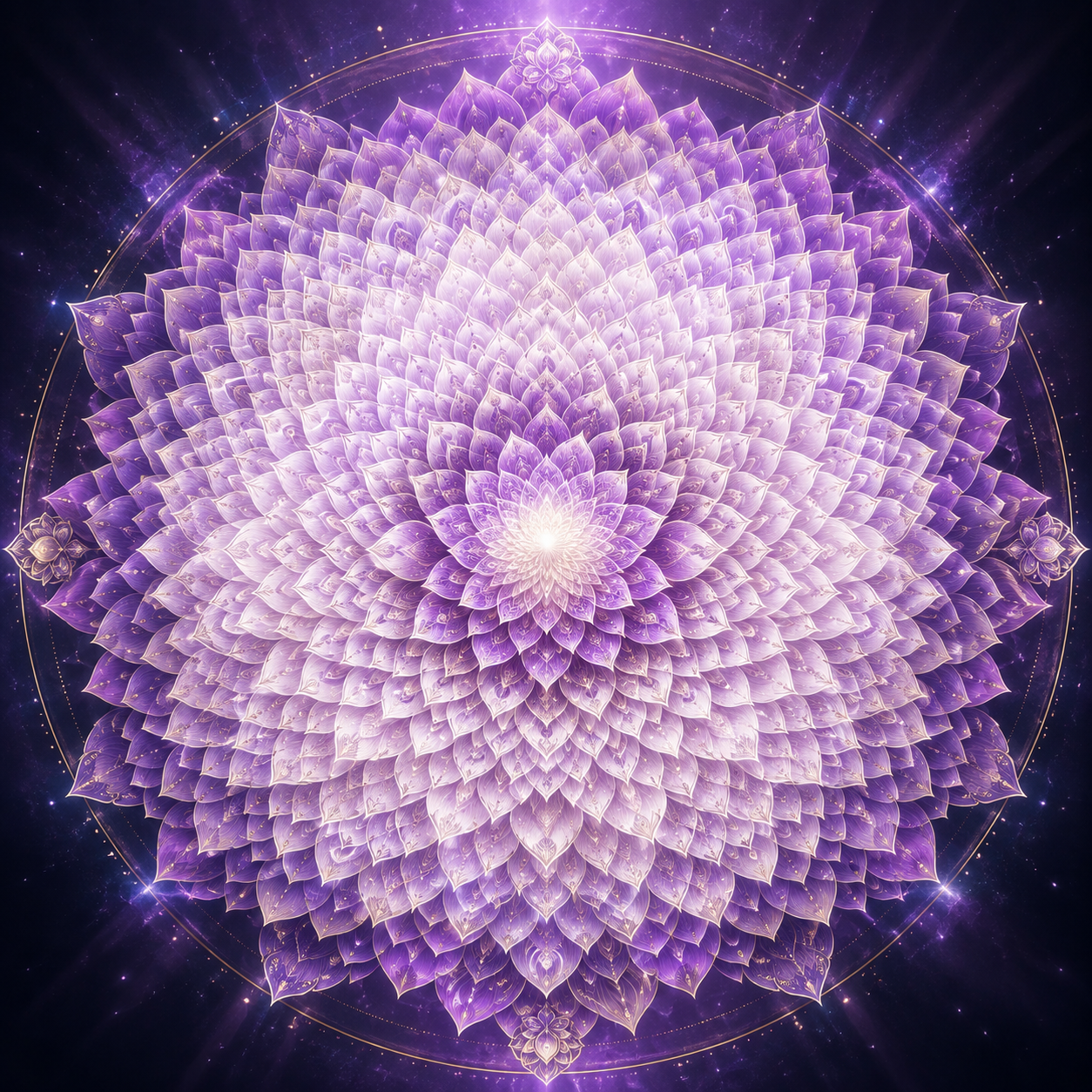
The Crown Chakra, known as Sahasrara in Sanskrit, is the seventh and final chakra in the traditional yogic chakra system. It represents the highest state of awareness and is traditionally associated with wisdom, consciousness, and a sense of unity with all life.
Unlike the lower six chakras, which relate to physical needs, emotions, personal identity, communication, and intuition, the Crown Chakra symbolises awareness beyond the individual self. In yogic philosophy, it is not viewed as something to be “activated” overnight but as a state of consciousness that develops through consistent self-awareness, meditation, ethical living, and spiritual practice.
The concept of chakras comes from ancient Indian yogic and Tantric traditions. While modern medicine does not recognise chakras as physical structures within the body, scientific research has shown that many practices associated with Crown Chakra development, such as meditation, mindfulness, controlled breathing, and yoga can improve mental well-being, reduce stress, enhance attention, and support emotional health.
This guide explores the Crown Chakra from both perspectives. You’ll learn its meaning in classical yogic philosophy, the symbolism behind Sahasrara, the traditional signs of balance and imbalance, practical ways to cultivate greater awareness, and how modern research relates to these practices.
Whether you are beginning your yoga journey or deepening an existing practice, understanding the Crown Chakra offers an opportunity to explore one of yoga’s most profound teachings: that lasting peace begins with awareness.
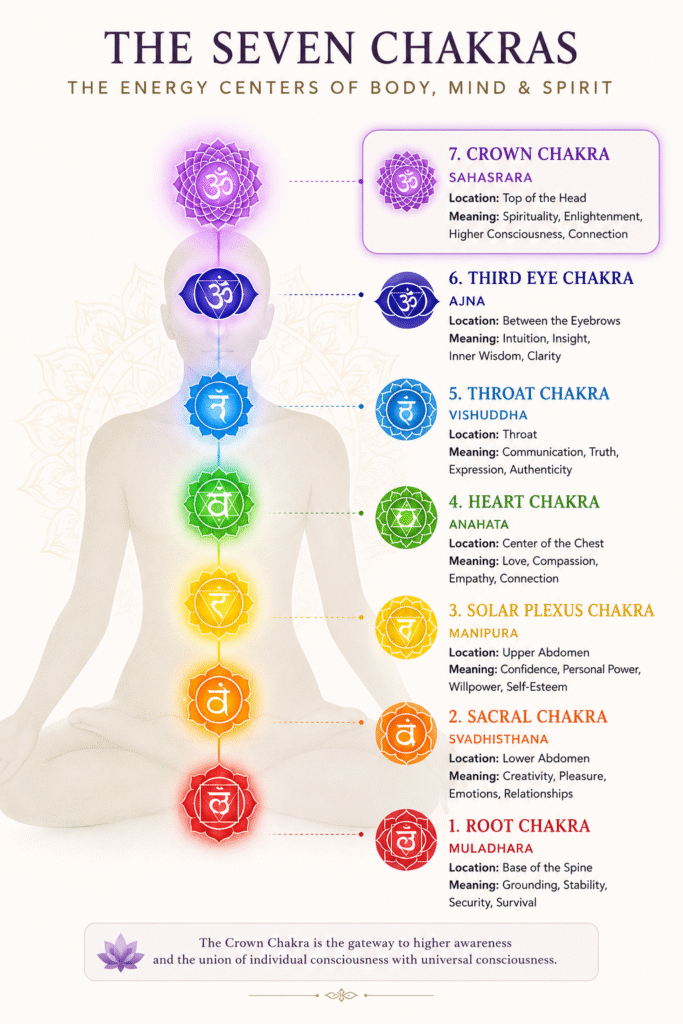
What Is the Crown Chakra?
The Crown Chakra, or Sahasrara, is considered the highest of the seven primary chakras in many yogic traditions. The Sanskrit word “Sahasrara” translates to “thousand-petalled”, referring to the symbolic lotus that represents infinite awareness, wisdom, and expanded consciousness.
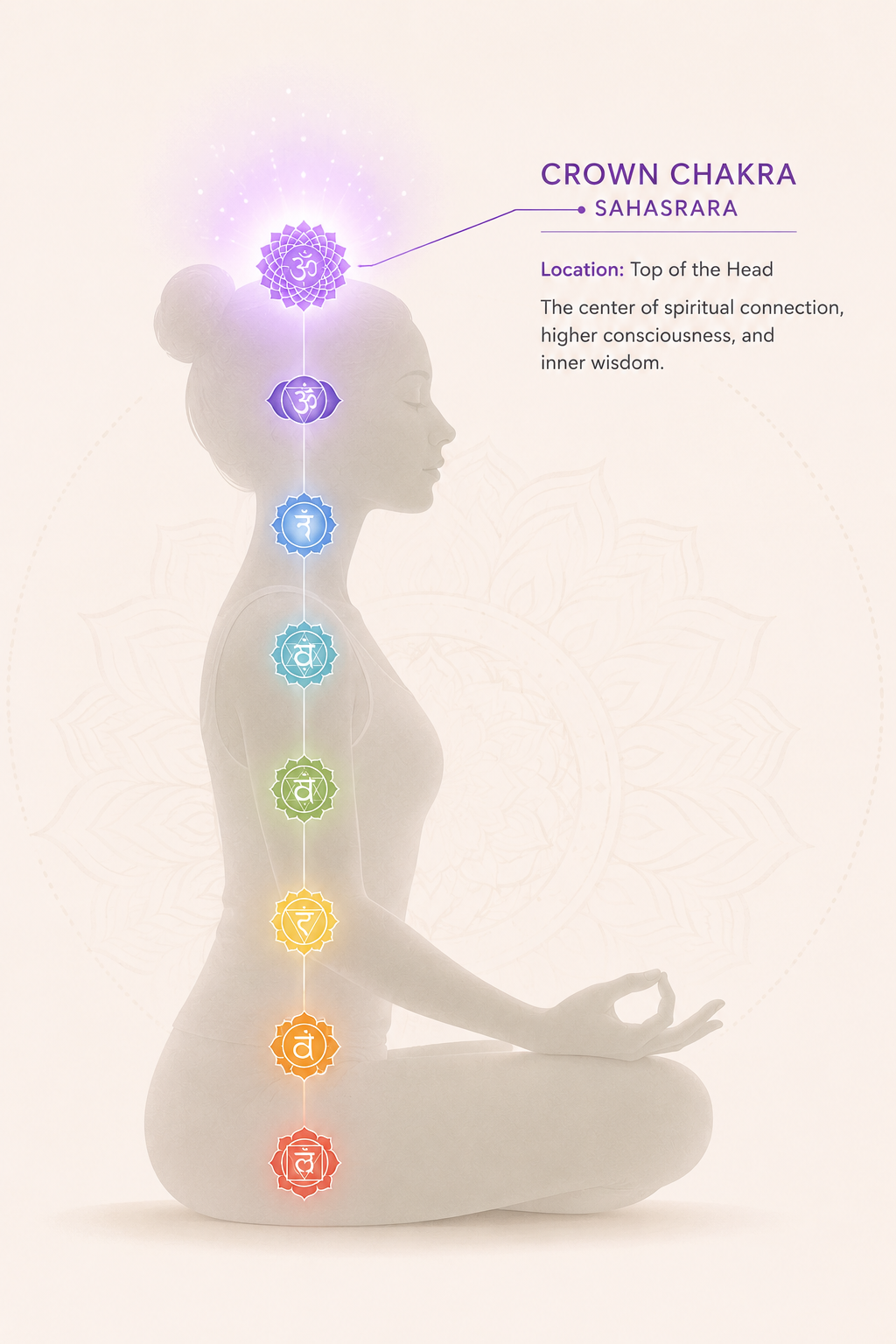
Traditionally, Sahasrara is located at the crown of the head. Unlike the lower chakras, it is not primarily associated with physical survival, emotions, or personal identity. Instead, it represents the culmination of the yogic journey, a state in which awareness extends beyond the constant activity of the mind.
In classical yoga and Tantra, the crown chakra is often described as the point where individual consciousness merges with universal consciousness. Rather than referring to a physical location or measurable energy centre, this description symbolises a profound shift in perception: moving from identifying solely with thoughts, emotions, and the ego toward experiencing a deeper sense of clarity, connection, and presence.
It is important to note that interpretations of the Crown Chakra have evolved. While many modern chakra systems associate Sahasrara with violet light, healing crystals, and specific affirmations, classical yogic texts place greater emphasis on meditation, self-discipline, ethical living, and the pursuit of self-realisation. Understanding this distinction helps us appreciate both the historical roots of the Crown Chakra and the ways it has been interpreted in contemporary wellness practices.
Why Is It Called Sahasrara?
The Sanskrit word “Sahasra” means “one thousand”. Combined with the suffix “-ara”, Sahasrara is commonly translated as “the thousand-petalled lotus”.
In Indian philosophy, the number one thousand is not meant to be taken literally. It symbolises limitlessness, completeness, and infinite potential. The lotus, a recurring symbol throughout yogic and Buddhist traditions, represents purity, transformation, and the unfolding of higher awareness.
Unlike a flower that blooms instantly, the thousand-petalled lotus symbolises gradual growth. Each petal can be understood as representing the continuous expansion of awareness through learning, self-reflection, meditation, compassion, and mindful living.
For this reason, Sahasrara is often viewed not as a destination but as an ongoing process of cultivating wisdom and presence.
The Origins of the Crown Chakra

The concept of the Crown Chakra (Sahasrara) originates from the ancient spiritual traditions of India, particularly Tantric Yoga and later Hatha Yoga. While the earliest Vedic texts do not describe the seven-chakra system as it is commonly understood today, the idea of subtle energy channels (nadis) and inner consciousness gradually evolved through centuries of yogic practice and philosophical exploration.
One of the most influential texts describing the chakra system is the Ṣaṭ-Cakra-Nirūpaṇa (The Description of the Six Chakras), written around the 16th century. Although the text primarily focuses on six principal chakras within the body, it also describes Sahasrara as the supreme centre of consciousness located beyond them. Other important yogic texts, including the Śiva Saṃhitā and later commentaries on Kundalini Yoga, further expanded the understanding of the Crown Chakra and its role in spiritual awakening.
Rather than viewing Sahasrara as a physical location, these traditions describe it as the symbolic culmination of inner growth, a state where the mind becomes calm, the ego softens, and awareness expands beyond ordinary perception.
What Does “Sahasrara” Mean?
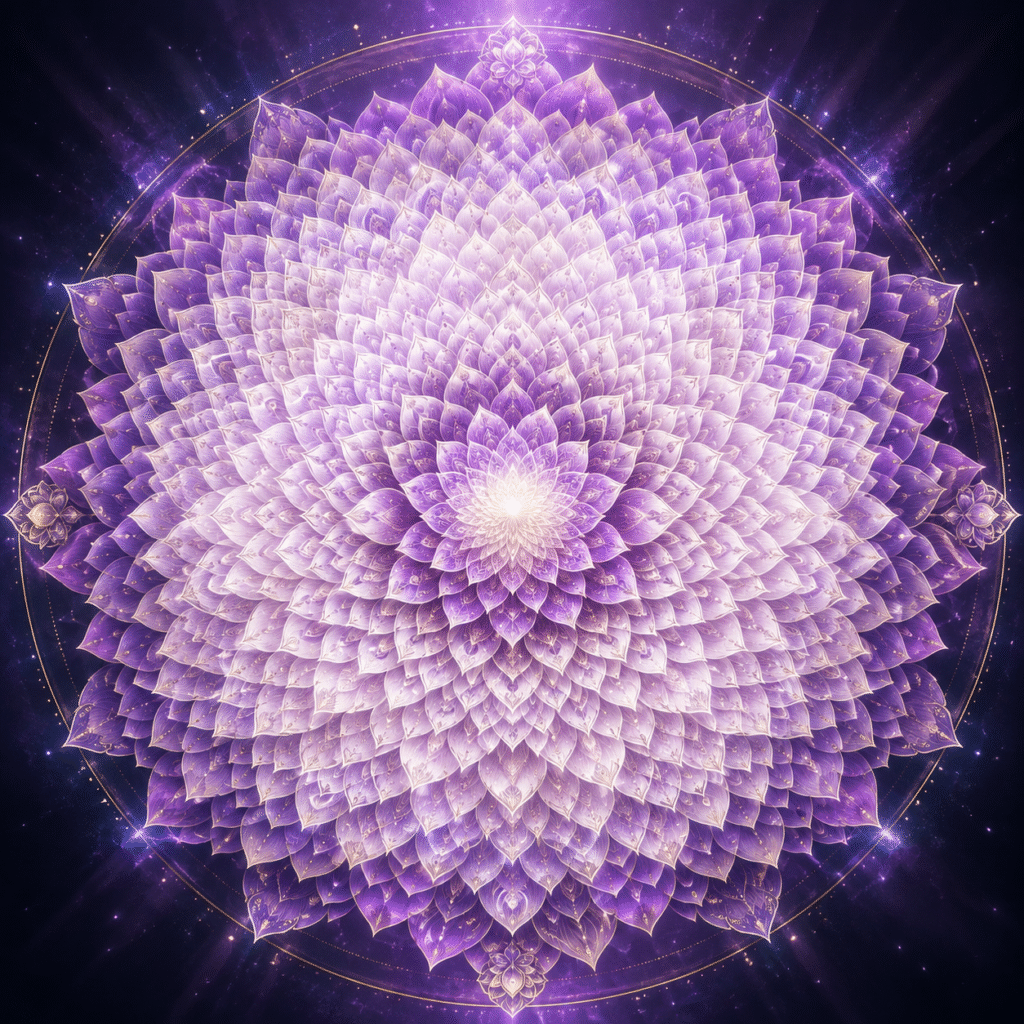
The Sanskrit word Sahasrara (सहस्रार) translates to “thousand-petalled”. It refers to the symbolic lotus that represents limitless awareness and the infinite potential of human consciousness.
In Indian philosophy, the number one thousand is symbolic rather than literal. It represents abundance, completeness, and boundless possibility. Likewise, the lotus is one of the most important symbols in Eastern traditions. Growing from muddy waters yet blooming into a beautiful flower, it represents purity, transformation, and the ability to rise above life’s challenges.
Together, the thousand-petalled lotus reminds practitioners that wisdom is not something acquired overnight. It unfolds gradually through discipline, self-reflection, compassion, and consistent practice.
Why Is the Crown Chakra Represented by a Thousand-Petalled Lotus?
Among all chakra symbols, the lotus of Sahasrara is the most elaborate. Unlike the four petals of the Root Chakra or the sixteen petals of the Throat Chakra, the thousand petals of Sahasrara symbolise infinite expansion rather than a fixed number.
Ancient yogic traditions use this imagery to express a state of consciousness that cannot be confined by ordinary thought or language. Instead of representing physical energy, the thousand petals symbolise limitless awareness, reminding practitioners that learning, growth, and self-discovery continue throughout life.
The fully blossomed lotus also reflects the culmination of the yogic path. It symbolises the integration of the lessons associated with all the preceding chakras, from stability and creativity to confidence, compassion, communication, and intuition.
Why Is the Crown Chakra Associated with Violet and White?
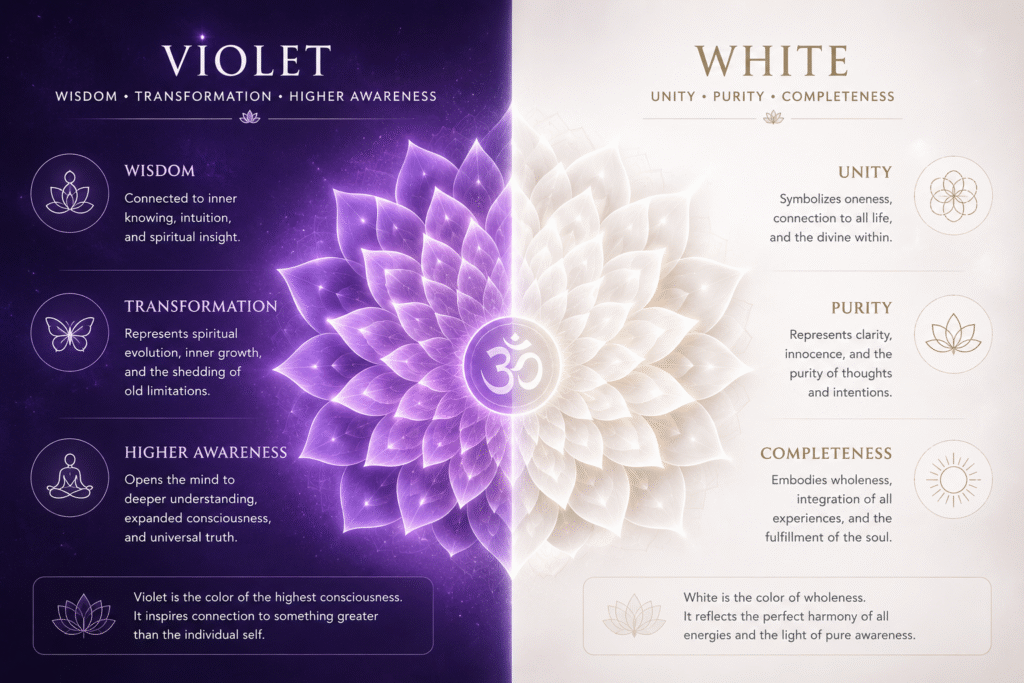
In modern chakra systems, the Crown Chakra is commonly represented by violet or white. While these colours are widely recognised today, they are largely the result of later interpretations rather than detailed descriptions found in the earliest yogic scriptures.
Violet is traditionally associated with transformation, wisdom, and expanded awareness. Positioned at the highest visible frequency of the colour spectrum, it has become a symbolic representation of higher consciousness and spiritual growth in many contemporary yoga and meditation traditions.
White, on the other hand, represents purity, unity, and completeness. Just as white light contains every visible colour, it symbolises the integration of all aspects of human experience. For this reason, many teachers consider white to reflect the idea that the Crown Chakra unites the qualities represented by the other six chakras.
Whether visualised as violet, white, or radiant light, these colours should be understood as symbolic tools for meditation rather than fixed rules within classical yoga.
Why Doesn’t the Crown Chakra Have an Element?
The first five chakras are traditionally associated with the five classical elements of Indian philosophy:
- Earth
- Water
- Fire
- Air
- Ether (Space)
The Crown Chakra is different.
In yogic philosophy, Sahasrara is considered beyond the five elements (Pancha Mahabhutas). Rather than representing another element, it symbolises a state of awareness that transcends the material world.
This does not suggest leaving everyday life behind. Instead, it reflects the understanding that clarity, wisdom, and inner peace arise when we are no longer completely identified with our thoughts, emotions, or external circumstances. It is a reminder that while we experience the physical world, our awareness is not limited to it.
The Meaning of Om and Silence
Unlike several other chakras that are traditionally associated with a specific bija (seed) mantra, the Crown Chakra occupies a unique place in yogic practice.
Many modern yoga traditions use Om (AUM) during Crown Chakra meditation because it has long been regarded as the sound symbolising universal consciousness. In the Mandukya Upanishad, Om is described as representing the totality of existence, waking, dreaming, deep sleep, and the silent awareness that underlies them all.
At the same time, several yogic traditions emphasise that silence itself is the deepest expression of Sahasrara. The purpose of meditation is not to create more mental activity but to cultivate the stillness in which awareness becomes clear.
For this reason, some teachers begin with chanting Om and gradually transition into silent meditation, allowing sound to become a bridge toward inner quiet rather than the final destination.
Signs of a Balanced and Imbalanced Crown Chakra
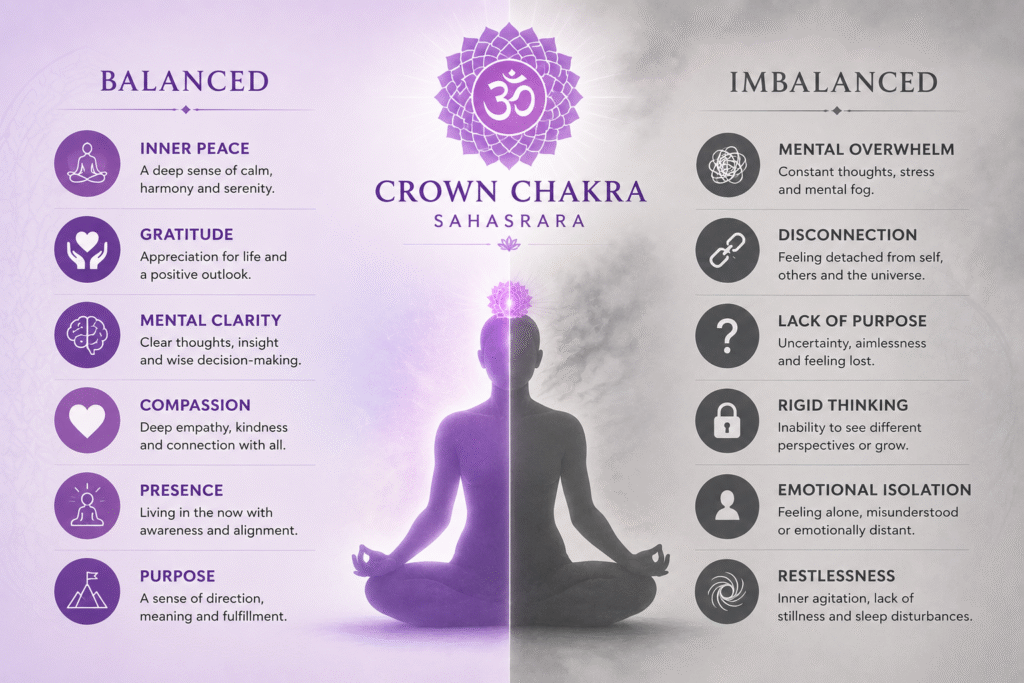
In yogic philosophy, the crown chakra represents awareness, wisdom, and a sense of connection that extends beyond personal identity. When it is described as being “balanced”, it does not imply perfection or constant happiness. Instead, it refers to a state in which a person is better able to experience life with clarity, presence, and inner stability.
Likewise, the idea of a “blocked” or “imbalanced” crown chakra comes from traditional yoga and energy-based practices rather than modern medical science. The experiences described below should be understood as symbolic or spiritual interpretations, not medical diagnoses.
Signs of a Balanced Crown Chakra
According to traditional yogic teachings, a balanced crown chakra allows a person to approach life with greater awareness, acceptance, and trust. Rather than constantly reacting to circumstances, they develop the ability to observe their thoughts with greater clarity and respond with intention.
Some commonly described qualities include:
Inner Peace
A balanced Crown Chakra is often associated with a quiet and steady mind. This doesn’t mean life becomes free from challenges, but that inner calm is less dependent on external circumstances.
Mental Clarity
People may find it easier to focus on what truly matters, make thoughtful decisions, and avoid becoming overwhelmed by unnecessary mental noise.
A Sense of Purpose
Traditional teachings describe Sahasrara as helping individuals feel connected to something greater than themselves. For some, this may be expressed through spirituality; for others, it may simply be a deep sense of meaning and direction in life.
Open-Mindedness
Rather than clinging to fixed beliefs or judgements, a balanced Crown Chakra encourages curiosity, lifelong learning, and respect for different perspectives.
Compassion Without Attachment
Yogic philosophy teaches that wisdom is expressed through kindness and empathy while maintaining healthy emotional balance. Compassion becomes an act of understanding rather than emotional exhaustion.
Gratitude
People with a balanced Crown Chakra are traditionally described as appreciating the present moment instead of constantly chasing the next achievement or possession.
Emotional Stability
Instead of suppressing emotions, they are able to acknowledge them without becoming completely controlled by them. This creates greater resilience during life’s challenges.
Signs of an Imbalanced Crown Chakra
In traditional chakra teachings, an imbalance in Sahasrara is believed to affect a person’s relationship with awareness, meaning, and perspective. These descriptions vary across different schools of yoga and should be viewed as philosophical interpretations rather than scientifically established conditions.
Commonly described signs include:
Feeling Disconnected
A person may experience a persistent sense of emptiness or disconnection from themselves, others, or the world around them.
Difficulty Finding Meaning
Life may begin to feel repetitive or directionless, making it harder to recognize a sense of purpose or fulfilment.
Constant Mental Overactivity
An overactive mind filled with continuous thinking, worry, or mental clutter can make it difficult to experience stillness or presence.
Rigid Thinking
Traditional teachings suggest that imbalance may lead to becoming overly attached to personal beliefs while resisting new ideas or different perspectives.
Lack of Self-Awareness
Instead of observing thoughts and emotions objectively, individuals may become completely identified with them, making it more difficult to respond calmly to situations.
Feeling Spiritually Disconnected
For those with a spiritual practice, an imbalance may be experienced as feeling distant from meditation, prayer, or personal values.
Emotional Isolation
Some traditions describe a tendency to withdraw from meaningful relationships or feel emotionally disconnected despite being surrounded by people.
Can the Crown Chakra Become Overactive?
Some modern chakra systems describe the possibility of an overactive crown chakra, although this concept is not consistently found in classical yogic texts.
It is often used to describe situations where a person becomes so focused on spiritual ideas that they lose connection with practical aspects of daily life. This may include neglecting responsibilities, constantly seeking extraordinary experiences, or believing that spiritual growth requires rejecting ordinary human experiences.
Traditional yoga encourages the opposite approach.
Ancient teachers emphasised that genuine wisdom is reflected in how we live each day, with humility, compassion, discipline, and balance. Awareness is not measured by dramatic experiences but by the ability to remain present, grounded, and kind in everyday life.
Common Misconceptions About the Crown Chakra
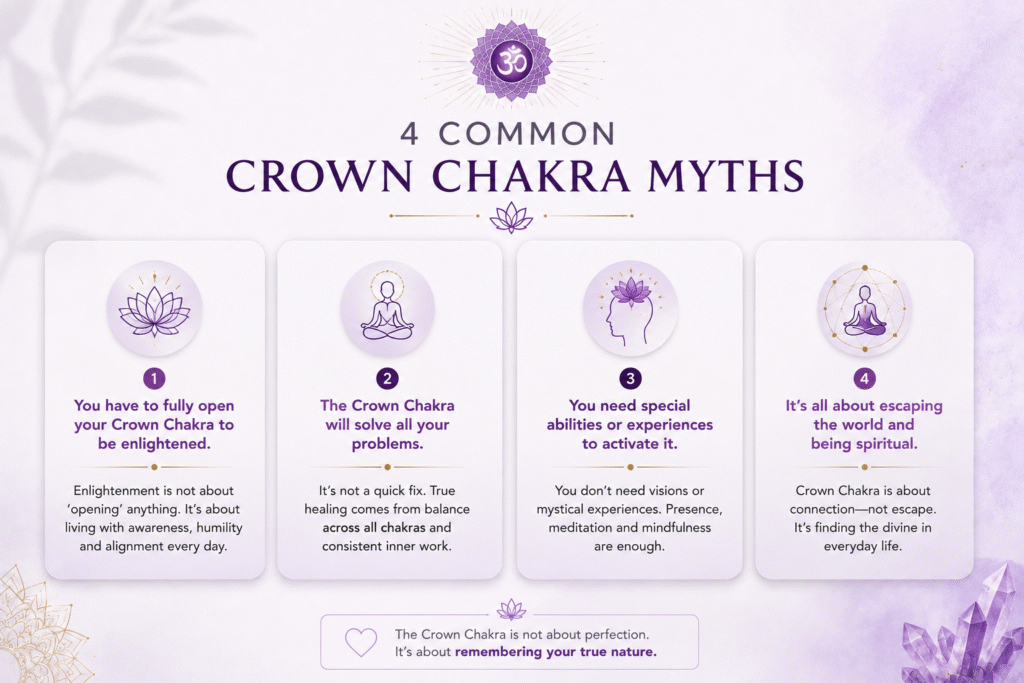
As interest in chakras has grown, so have misunderstandings. Here are a few of the most common myths:
Myth 1: The Crown Chakra Can Be “Opened” Overnight
Ancient yogic teachings describe spiritual growth as a gradual process developed through consistent practice, self-discipline, and self-inquiry, not through a single meditation session or workshop.
Myth 2: A Blocked Crown Chakra Causes Disease
There is no scientific evidence showing that a blocked Crown Chakra directly causes specific physical illnesses. If you are experiencing persistent physical or mental health concerns, it is important to seek guidance from a qualified healthcare professional.
Myth 3: Spiritual Growth Means Escaping Everyday Life
Yoga does not encourage withdrawing from life. Instead, it teaches us to become more present, compassionate, and aware while fully participating in our daily responsibilities.
Myth 4: Meditation Guarantees Enlightenment
Meditation is a valuable practice for cultivating awareness, but traditional yoga views enlightenment as the result of lifelong inner development rather than a guaranteed outcome of any single technique.
A Balanced Crown Chakra Is About Awareness, Not Perfection
One of the greatest misconceptions about the Crown Chakra is the belief that balance means reaching a permanent state of happiness or spiritual perfection.
Yogic philosophy offers a more realistic perspective.
Awareness does not remove life’s challenges. It changes how we relate to them.
Moments of stress, uncertainty, frustration, and sadness are part of being human. A balanced Crown Chakra is traditionally understood as developing the ability to experience these moments without becoming completely consumed by them. It is less about escaping difficult emotions and more about meeting them with clarity, patience, and wisdom.
In this sense, the Crown Chakra is not the end of a journey but an ongoing practice of returning to awareness, again and again.
How to Balance the Crown Chakra
In yogic philosophy, balancing the Crown Chakra is not about forcing a spiritual experience or trying to “activate” a hidden energy. Instead, it is a gradual process of cultivating awareness, reducing mental distractions, and developing a deeper connection with yourself through consistent practice.
The following practices are rooted in traditional yoga and mindfulness. While they are commonly associated with the Crown Chakra, their benefits often extend to overall mental and emotional well-being.
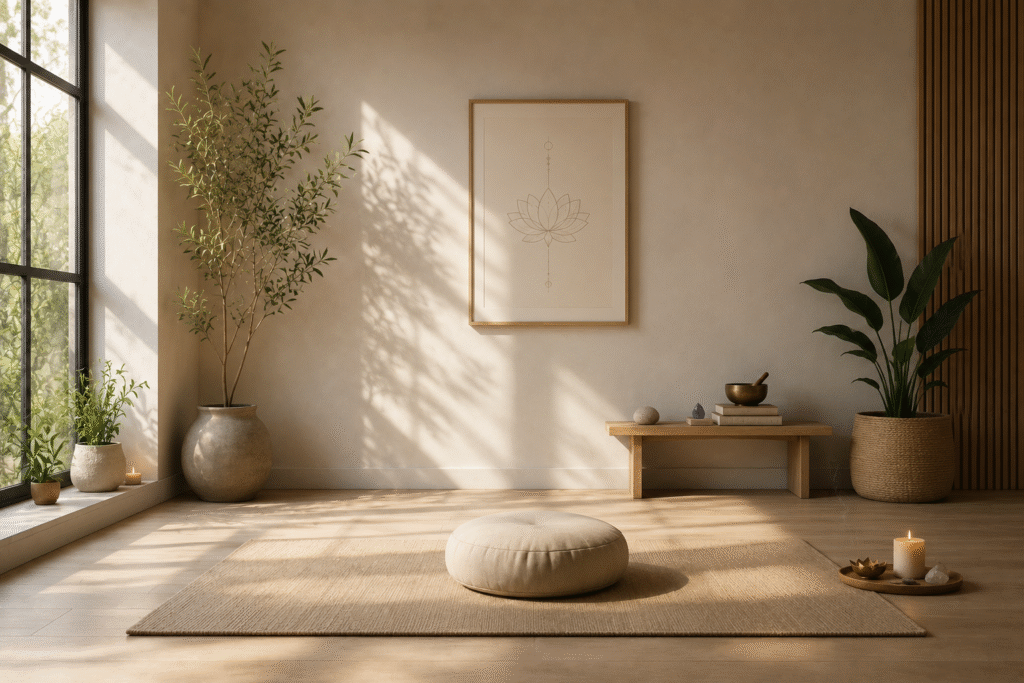
1. Practice Daily Meditation
Meditation is considered one of the most important practices for cultivating the qualities traditionally associated with the Crown Chakra.
Rather than trying to stop your thoughts, meditation encourages you to observe them without judgement. Over time, this practice can help create greater mental clarity, emotional balance, and self-awareness.
If you’re new to meditation, begin with just 5 to 10 minutes each day. Sit comfortably, bring your attention to your natural breath, and gently return your focus whenever the mind wanders.
Consistency is far more valuable than long sessions practised occasionally.
2. Spend Time in Silence
Modern life is filled with constant stimulation, notifications, conversations, music, and endless streams of information. While staying connected has many benefits, it also leaves little room for stillness.
Many yogic traditions regard silence as a valuable practice because it creates space to observe the mind without additional distractions.
This doesn’t require retreating to a remote mountain or disconnecting from daily life. Even a few quiet minutes each day, without your phone, television, or background noise, can become an opportunity to reconnect with your thoughts and simply be present.
3. Develop a Mindfulness Practice
Mindfulness means paying full attention to the present moment with openness and curiosity.
Whether you’re eating, walking, practising yoga, or having a conversation, mindfulness encourages you to experience what is happening without becoming lost in thoughts about the past or future.
This simple shift in awareness reflects one of the central qualities traditionally associated with the Crown Chakra: being fully present with life as it unfolds.
4. Maintain a Regular Yoga Practice
While no single yoga posture “opens” the Crown Chakra, a consistent yoga practice helps prepare the body and mind for meditation by improving posture, breath awareness, and concentration.
Gentle, mindful movement followed by quiet meditation is a common approach in many traditional yoga schools.
The intention is not to chase extraordinary experiences but to cultivate steadiness, comfort, and awareness.
Best Yoga Poses for the Crown Chakra
The following postures are commonly included in practices that emphasise stillness, balance, and meditation.
Lotus Pose (Padmasana)
One of the most recognised meditation postures, Padmasana encourages an upright spine, steady breathing, and a stable seated position for longer periods of meditation.
Easy Pose (Sukhasana)
A comfortable cross-legged position suitable for most practitioners. It supports mindful breathing and meditation without placing unnecessary strain on the body.
Corpse Pose (Savasana)
Although often practised at the end of a yoga session, Savasana provides an opportunity to integrate the effects of movement and cultivate deep relaxation and awareness.
Mountain Pose (Tadasana)
This foundational standing posture develops balance, alignment, and mindful awareness of the body while encouraging steady breathing.
Headstand (Sirsasana) – Advanced Practice
Some modern yoga traditions associate headstands with the crown chakra because of their inverted position.
However, headstand is an advanced posture that should only be practised under the guidance of a qualified yoga teacher. It is not necessary for cultivating awareness or balancing the Crown Chakra, and many practitioners develop a meaningful meditation practice without ever practising inversions.
5. Practice Conscious Breathing
The breath plays a central role in yoga because it serves as a bridge between the body and the mind.
Slow, steady breathing naturally encourages relaxation and improves present-moment awareness.
Simple practices such as Dirgha Pranayama (Three-Part Breath) or Nadi Shodhana (Alternate Nostril Breathing) are often used before meditation to settle the mind and prepare for stillness.
If you are new to pranayama, begin gently and learn from a qualified instructor whenever possible.
6. Spend Time in Nature
Nature has long been regarded as a teacher in yogic philosophy.
Walking through a forest, sitting near a lake, or simply observing the sky can encourage a sense of perspective and presence that is often difficult to find in busy daily routines.
Rather than seeking extraordinary experiences, allow nature to remind you of something simple: the value of slowing down and paying attention.
7. Reflect Through Journaling
Self-inquiry is an important aspect of many yogic traditions.
Journaling offers a practical way to explore your thoughts, beliefs, and experiences with honesty.
Instead of trying to find the “right” answers, ask questions that encourage reflection, such as:
- What brings genuine meaning to my life?
- When do I feel most present?
- What beliefs no longer serve me?
- How can I bring greater awareness into my daily routine?
The goal is not perfection but greater understanding of yourself.
8. Practice Gratitude
Gratitude shifts attention from what is missing to what is already present.
This does not mean ignoring life’s challenges. Rather, it encourages recognising moments of kindness, growth, learning, and connection that often go unnoticed.
A simple daily gratitude practice can help cultivate a calmer and more balanced perspective.
9. Crown Chakra Affirmations
Affirmations are widely used in modern wellness practices as positive statements that encourage mindful reflection. While they are not a traditional requirement in classical yoga, many people find them helpful when combined with meditation and self-awareness.
You may choose affirmations that resonate with your personal practice, such as:
- I trust the wisdom within me.
- I welcome clarity and awareness.
- I am open to learning and personal growth.
- I choose presence over distraction.
- My mind is calm, clear, and focused.
- I approach life with curiosity and compassion.
- I am connected to the present moment.
- I find peace in stillness.
- I live with intention and purpose.
- I embrace each day with awareness and gratitude.
Daily Habits That Support a Balanced Crown Chakra
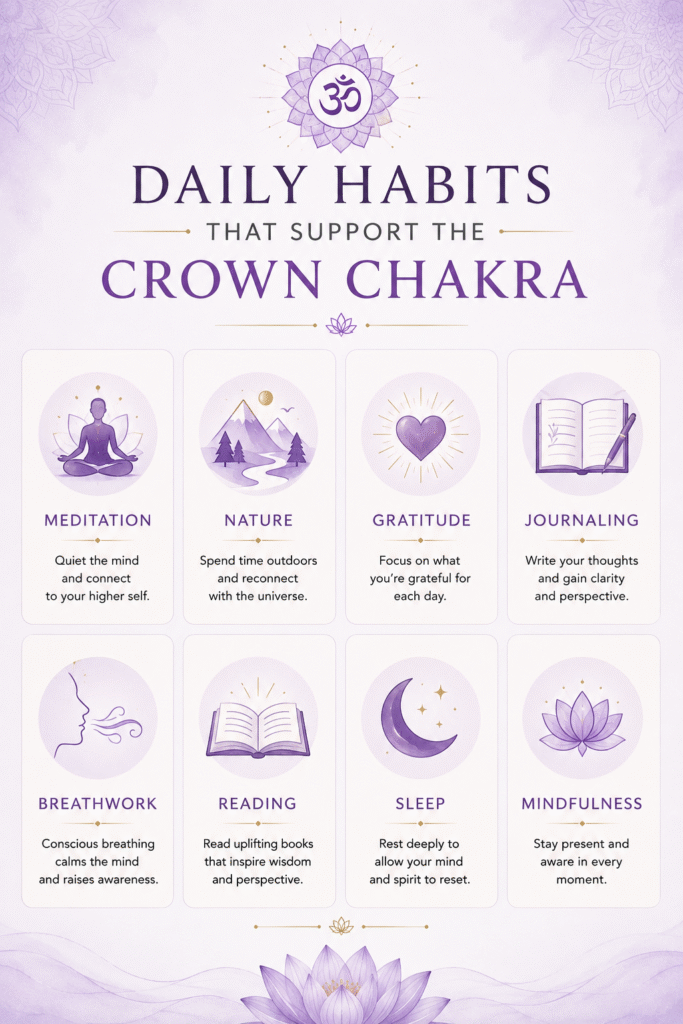
Small, consistent habits often have a greater impact than occasional intensive practices.
Consider incorporating these simple routines into your day:
- Meditate for 10–15 minutes.
- Spend a few moments in silence without digital distractions.
- Practice mindful breathing.
- Read or reflect on inspiring teachings.
- Take a mindful walk outdoors.
- Keep a gratitude journal.
- Maintain a regular sleep routine.
- End your day with a few minutes of quiet reflection.
Remember, the goal is not to achieve perfection but to build a lifestyle that supports greater awareness over time.
What Does Science Say About the Crown Chakra?
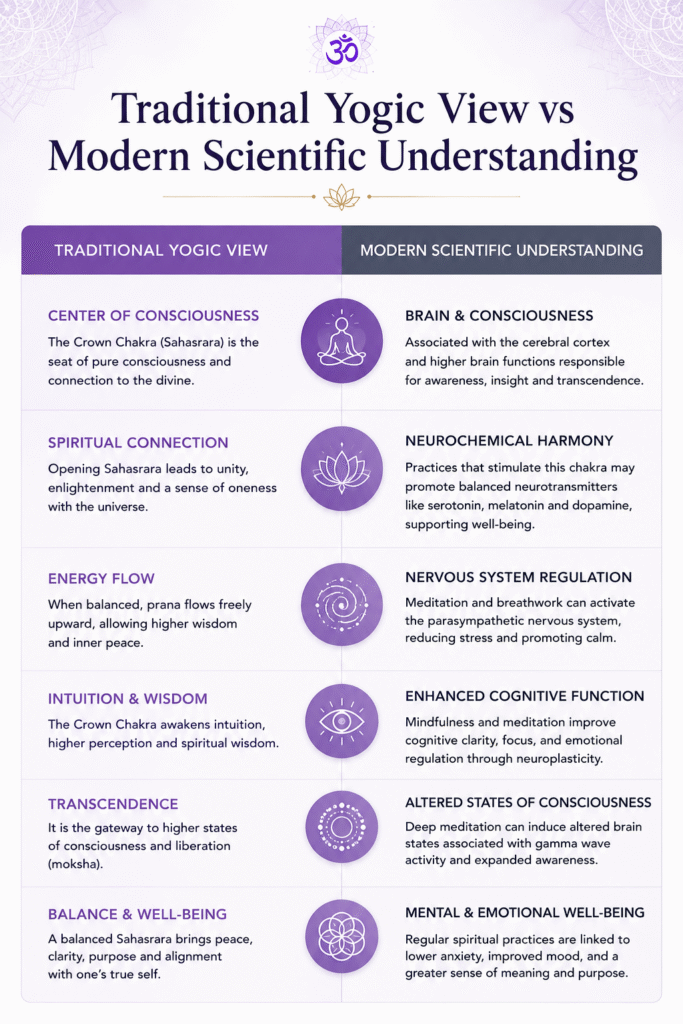
The crown chakra has been described in yogic philosophy for centuries as the centre of awareness, wisdom, and higher consciousness. However, it is important to distinguish between traditional spiritual teachings and current scientific understanding.
Modern science has not identified chakras as physical structures within the body, nor has it confirmed the existence of subtle energy centres in the way they are described in yogic traditions.
At the same time, many practices traditionally associated with the Crown Chakra, such as meditation, mindfulness, yoga, and controlled breathing, have been extensively studied for their effects on physical and mental well-being.
Understanding this distinction allows us to appreciate the wisdom of yoga while remaining grounded in evidence.
Are Chakras Scientifically Proven?
At present, there is no scientific evidence confirming that chakras exist as measurable anatomical or physiological structures.
Unlike the brain, heart, or nervous system, chakras cannot currently be detected through medical imaging or laboratory testing.
The chakra system should therefore be understood as part of a traditional philosophical and spiritual framework rather than an established scientific model of the human body.
For many practitioners, chakras serve as symbolic maps for understanding personal growth, emotional awareness, and meditation rather than literal physical organs.
What Research Says About Meditation
Although science has not validated the existence of chakras, it has extensively explored the effects of meditation.
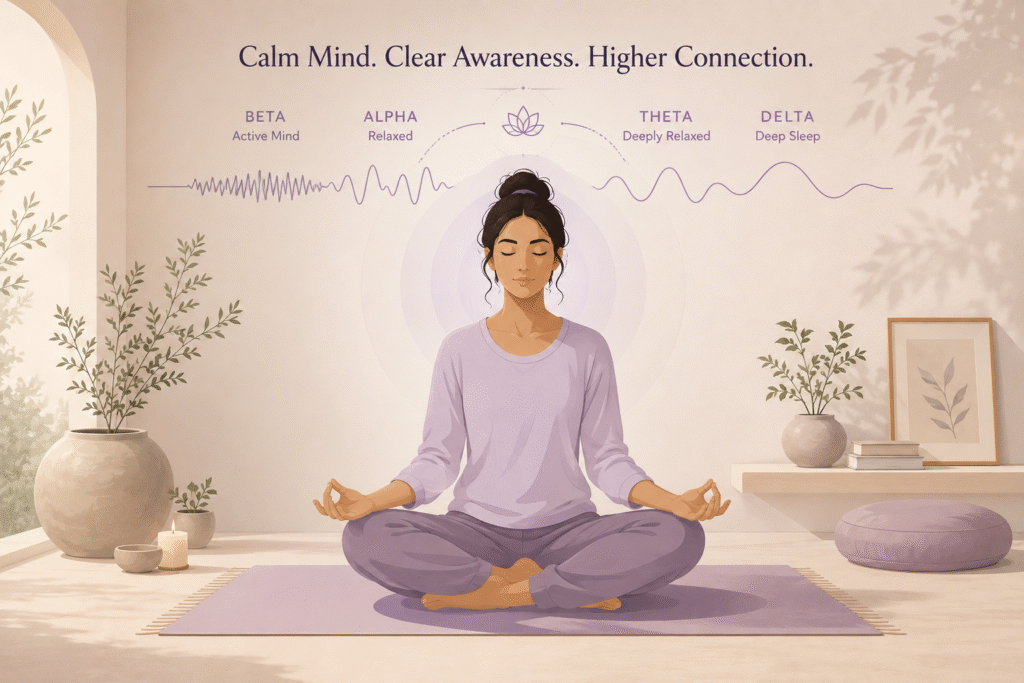
Research suggests that regular meditation may:
- Reduce perceived stress.
- Improve emotional regulation.
- Support attention and concentration.
- Enhance self-awareness.
- Improve overall psychological well-being.
- Promote better sleep quality in some individuals.
Brain imaging studies have also shown that long-term meditation is associated with changes in brain regions involved in attention, emotional processing, and self-reflection. These findings help explain why meditation has become a valuable practice in both healthcare and wellness settings.
It is important to remember that these benefits are linked to meditation itself, not specifically to the activation of any particular chakra.
What Research Says About Yoga
Yoga combines physical movement, breath awareness, and focused attention into a single practice.
According to current research, regular yoga practice may help:
- Improve flexibility and balance.
- Reduce symptoms of stress and anxiety.
- Support emotional resilience.
- Enhance body awareness.
- Improve overall quality of life.
Many yoga practitioners also report experiencing greater calm, clarity, and connection after consistent practice. While these experiences are often described in the language of the chakra system, science generally explains them in terms of the combined effects of movement, breathing, mindfulness, and nervous system regulation.
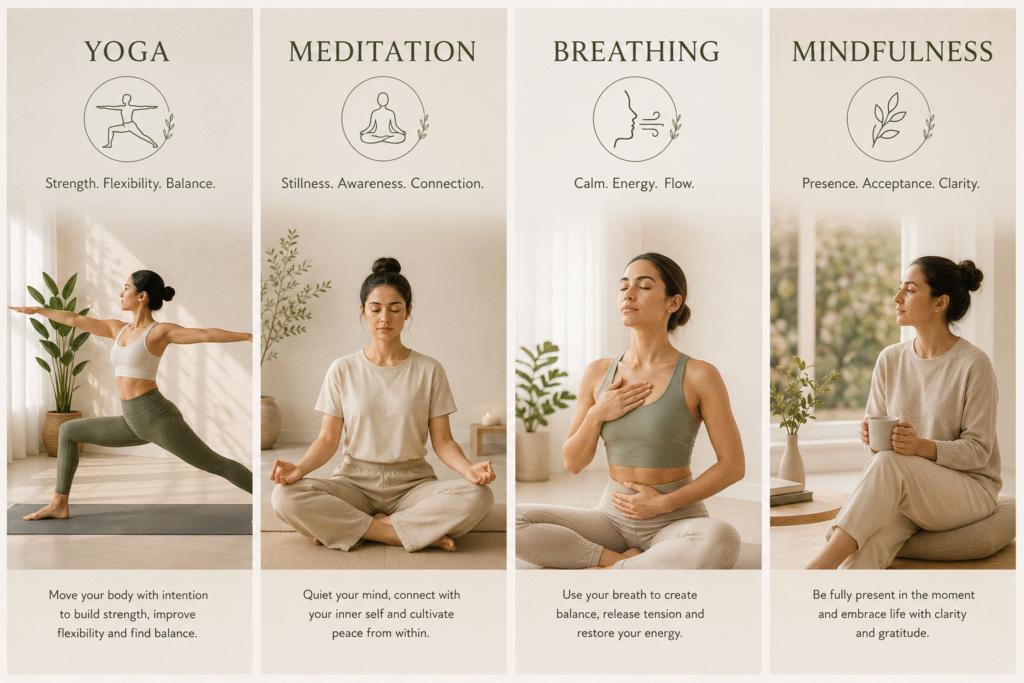
What Research Says About Mindfulness
Mindfulness involves intentionally paying attention to the present moment with openness and curiosity.
Over the past two decades, mindfulness has become one of the most widely researched areas in psychology.
Studies suggest that mindfulness-based practices may help:
- Reduce chronic stress.
- Improve attention.
- Increase emotional awareness.
- Support resilience during difficult situations.
- Reduce rumination and repetitive thinking.
These outcomes closely align with many of the qualities traditionally associated with a balanced Crown Chakra, including greater clarity, presence, and emotional steadiness.
The Crown Chakra and the Brain
Some modern wellness traditions associate the Crown Chakra with the pineal gland, pituitary gland, or specific regions of the brain.
However, these associations are symbolic rather than scientifically established.
Classical yogic texts do not describe the crown chakra using modern anatomical terms because these concepts developed long before contemporary neuroscience.
Today, many teachers use these comparisons as educational tools rather than literal biological explanations.
At present, there is no scientific evidence demonstrating that the crown chakra directly controls the pineal gland, pituitary gland, or any other specific structure within the brain.
Science and Spiritual Experience
Experiences such as profound peace, a sense of interconnectedness, deep presence, or moments of expanded awareness are described across many spiritual traditions.
Psychology and neuroscience continue to study these experiences, particularly in relation to meditation and contemplative practices.
While researchers have identified changes in brain activity during meditation, science cannot currently determine whether these experiences represent spiritual awakening, altered states of consciousness, or other psychological processes.
For this reason, spiritual experiences remain deeply personal and are often interpreted differently depending on an individual’s cultural, philosophical, or religious background.
Traditional Yogic Understanding vs. Current Scientific Understanding
| Traditional Yogic Perspective | Current Scientific Understanding |
|---|---|
| The crown chakra is the highest centre of awareness and consciousness. | The concept of chakras has not been scientifically verified as a physical system. |
| Meditation supports greater awareness and inner stillness. | Strong evidence suggests meditation can improve attention, reduce stress, and support emotional well-being. |
| Sahasrara symbolises unity and self-realisation. | Feelings of connection and meaning are studied in psychology, but not as measurable chakra activity. |
| Yoga prepares the body and mind for higher awareness. | Research supports yoga for flexibility, stress management, and overall well-being. |
| Conscious breathing calms the mind and supports meditation. | Controlled breathing has been shown to influence relaxation, attention, and autonomic nervous system activity. |
Why This Balance Matters
One of yoga’s greatest strengths is that it invites exploration rather than certainty.
You do not need to choose between science and tradition.
Scientific research helps us understand how practices such as meditation, yoga, and breathwork influence the body and mind. Yogic philosophy offers a framework for exploring awareness, meaning, and personal growth through centuries of lived experience.
Whether you approach the Crown Chakra as a spiritual symbol, a philosophical teaching, or a personal mindfulness practice, its central message remains remarkably relevant: cultivating greater awareness can change how we experience ourselves and the world around us.
FAQ
What is the Crown Chakra?
The Crown Chakra, or Sahasrara, is the seventh chakra in the traditional yogic chakra system. It is associated with awareness, wisdom, inner peace, and a sense of connection that extends beyond the individual self. In yogic philosophy, it represents the highest state of consciousness and the culmination of personal and spiritual growth.
Where is the Crown Chakra located?
The crown chakra is traditionally located at the top of the head, often referred to as the crown. Unlike physical organs, its location is symbolic and represents higher awareness rather than a measurable anatomical structure.
What colour is the Crown Chakra?
The Crown Chakra is most commonly represented by violet or white.
- Violet symbolises transformation, wisdom, and expanded awareness.
- White represents purity, unity, and the integration of all aspects of life.
These colours are symbolic and are primarily found in later yogic and modern chakra traditions.
What are the signs of a balanced Crown Chakra?
According to traditional yogic teachings, a balanced crown chakra is associated with:
- Inner peace
- Mental clarity
- Self-awareness
- Gratitude
- Compassion
- A sense of purpose
- Openness to learning
- Emotional balance
These qualities are viewed as outcomes of consistent self-awareness and practice rather than permanent states.
What are the signs of an imbalanced Crown Chakra?
Traditional interpretations commonly describe an imbalanced Crown Chakra as being associated with:
- Feeling disconnected
- Lack of purpose
- Mental overwhelm
- Rigid thinking
- Difficulty practising mindfulness
- Feeling spiritually disconnected
- Emotional isolation
These descriptions are part of yogic philosophy and should not be interpreted as medical diagnoses.
How can I balance my Crown Chakra?
Traditional yoga recommends cultivating awareness through consistent daily practice rather than seeking quick results.
Helpful practices include:
- Meditation
- Mindfulness
- Gentle yoga
- Conscious breathing
- Spending time in nature
- Gratitude journaling
- Quiet reflection
- Maintaining healthy daily routines
The goal is not perfection but developing greater clarity and presence over time.
Does meditation open the crown chakra?
Meditation is one of the practices most commonly associated with the Crown Chakra because it develops awareness and mental stillness.
However, traditional yoga views meditation as a lifelong practice rather than a technique that guarantees a sudden spiritual awakening. Its purpose is to cultivate greater presence, wisdom, and self-understanding through consistent practice.
Is there scientific evidence for the Crown Chakra?
The chakra system is part of ancient yogic philosophy and has not been scientifically verified as a physical system within the body.
However, many practices associated with the Crown Chakra, including meditation, yoga, mindfulness, and controlled breathing, have been widely researched and are associated with benefits such as reduced stress, improved attention, and enhanced emotional well-being.
Which yoga poses are associated with the Crown Chakra?
Several postures are commonly included in Crown Chakra practices because they encourage stillness, balance, and meditation.
These include:
- Padmasana (Lotus Pose)
- Sukhasana (Easy Pose)
- Tadasana (Mountain Pose)
- Savasana (Corpse Pose)
- Sirsasana (Headstand – for experienced practitioners under proper guidance)
Rather than “activating” the Crown Chakra, these poses help create a stable foundation for meditation and mindful awareness.
Can beginners work with the Crown Chakra?
Absolutely.
The Crown Chakra is not reserved for advanced yoga practitioners. Anyone can begin cultivating its qualities by practising mindfulness, meditation, self-reflection, and simple breathing exercises.
In yoga, awareness develops gradually through regular practice rather than experience level.

The Crown Chakra reminds us that yoga is about more than physical postures. It is a lifelong practice of developing awareness, wisdom, and a deeper understanding of ourselves.
Ancient yogic teachings describe Sahasrara as the highest expression of consciousness, not because it is separate from everyday life, but because it invites us to experience life with greater clarity, compassion, and presence.
Whether you approach the Crown Chakra through meditation, yoga, mindful breathing, or simple moments of quiet reflection, its message remains the same: meaningful growth begins with awareness.
At ANAYA, we believe that ancient teachings become most valuable when they can be understood and applied in modern life. You don’t need to pursue extraordinary experiences to begin this journey. Sometimes, the most profound practice is simply learning to be fully present with yourself, one breath at a time.
Our Research Philosophy
At ANAYA, we believe in honouring the wisdom of traditional yogic teachings while presenting them responsibly. This guide is based on classical yoga texts, respected modern yoga literature, and current scientific research where applicable. When discussing traditional concepts such as chakras, symbolism, or Kundalini, we clearly distinguish them from findings supported by modern scientific evidence.
References & Further Reading
This article draws upon classical yogic literature and contemporary research to provide a balanced perspective.
Classical Yogic Texts
- Haṭha Yoga Pradīpikā
- Śiva Saṃhitā
- Ṣaṭ-Cakra-Nirūpaṇa
- Yoga Sūtras of Patañjali
- Mandukya Upanishad
Modern Books
- B.K.S. Iyengar – Light on Yoga
- T.K.V. Desikachar – The Heart of Yoga
- James Mallinson & Mark Singleton – The Roots of Yoga
Scientific Research
- Goyal M. et al. (2014). Meditation Programs for Psychological Stress and Well-being.
- Tang Y.Y. et al. (2015). The Neuroscience of Mindfulness Meditation.
- National Center for Complementary and Integrative Health (NCCIH)