Have you ever had a feeling that something simply felt right before there was any logical explanation?
Or sensed the answer to a problem before your mind had fully worked it out?
These moments are often described as intuition. The quiet inner knowing that arises beyond ordinary thought.
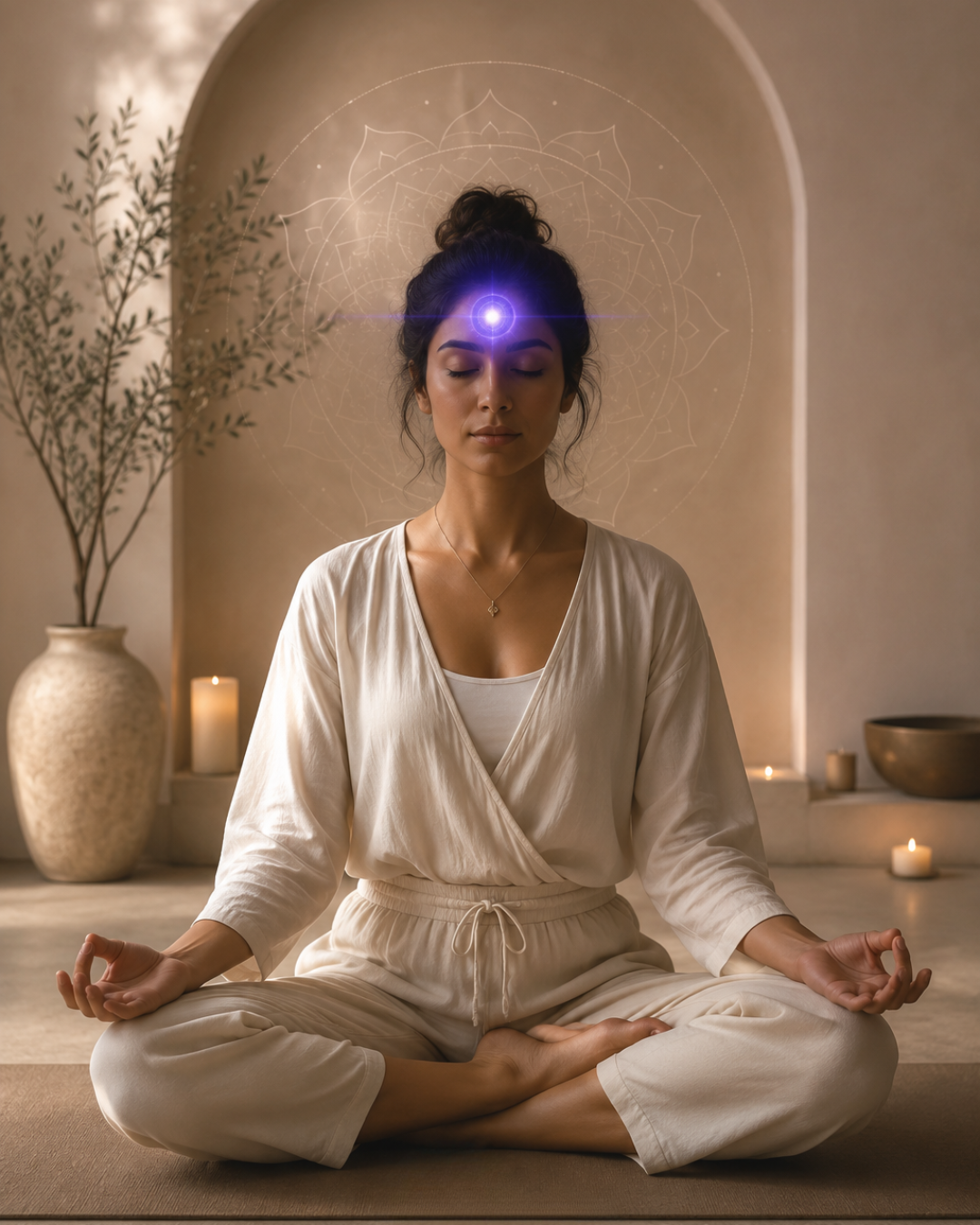
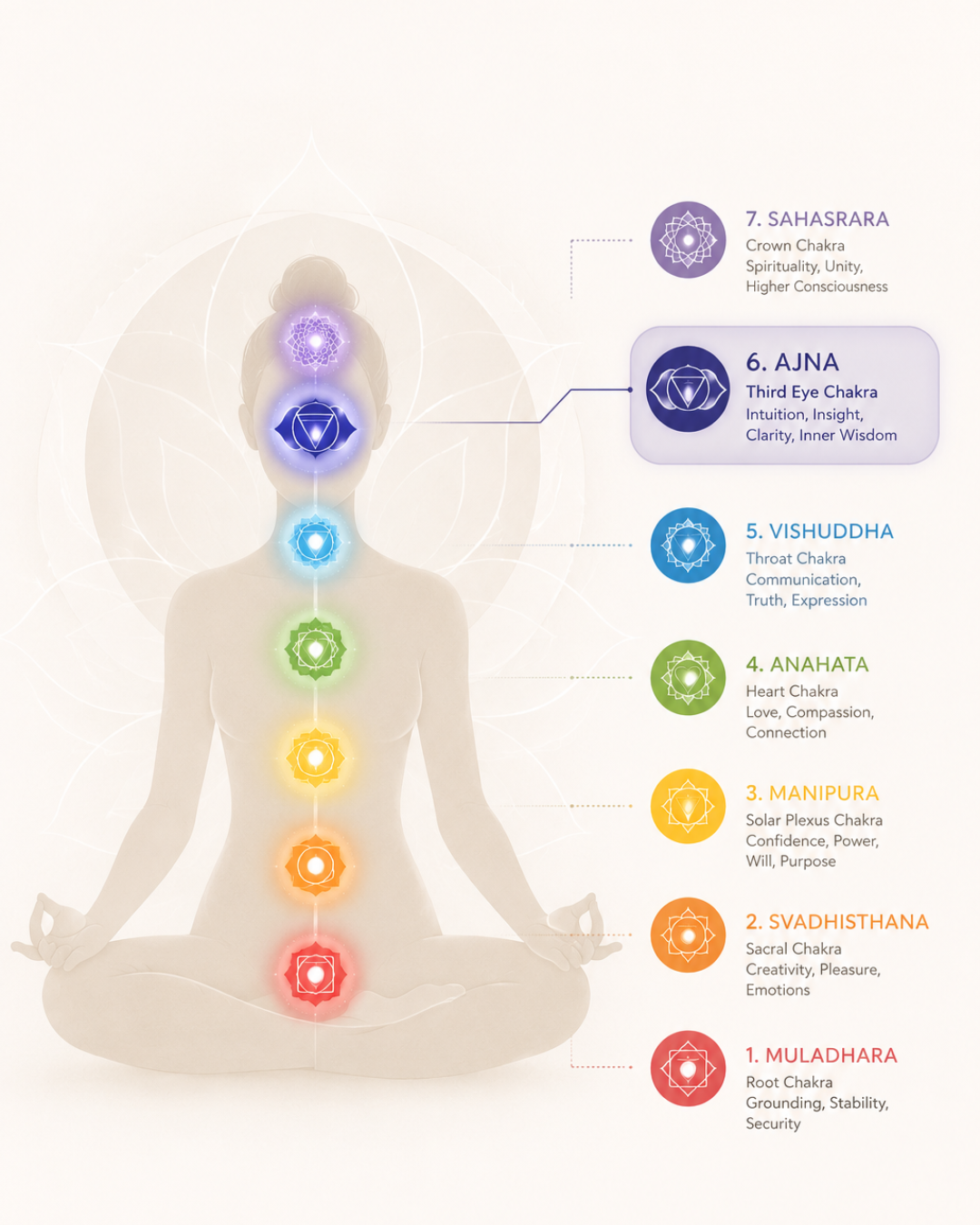
In yogic philosophy, this capacity for insight is associated with the Third Eye Chakra, or Ajna Chakra, the sixth of the seven primary chakras. Rather than being about predicting the future or acquiring mystical powers, the Third Eye symbolises clarity, perception, discernment, and the ability to observe life with wisdom.
When this energy center is balanced, we tend to think clearly, trust our intuition, and respond thoughtfully instead of reacting impulsively. When it is out of balance, we may experience confusion, overthinking, difficulty making decisions, or feeling disconnected from our inner guidance.
In this guide, you’ll explore:
- What the Third Eye Chakra is
- Its traditional symbolism
- Signs of balance and imbalance
- Yoga poses that support awareness
- Breathwork and meditation practices
- Foods and affirmations associated with Ajna
- Everyday habits that cultivate greater clarity
Whether you’re new to chakra philosophy or deepening your existing practice, this guide offers grounded, practical ways to work with the Third Eye Chakra in daily life.
What is the Third Eye Chakra?
The Third Eye Chakra, known in Sanskrit as Ajna, is traditionally regarded as the center of intuition, inner wisdom, perception, and insight.
The word Ajna translates to “command”, “perceive”, or “authority”. In yogic philosophy, it represents the place where higher understanding guides our thoughts and actions, encouraging us to move beyond habitual reactions and see situations with greater clarity.
Unlike the lower chakras, which are often associated with physical survival and emotional experience, the Third Eye invites awareness that extends inward. It encourages observation, reflection, and the ability to distinguish between fear-driven thinking and genuine intuition.
Rather than relying solely on external information, a balanced Ajna Chakra supports trust in one’s inner wisdom while remaining grounded and discerning.
Where is the third eye chakra located?
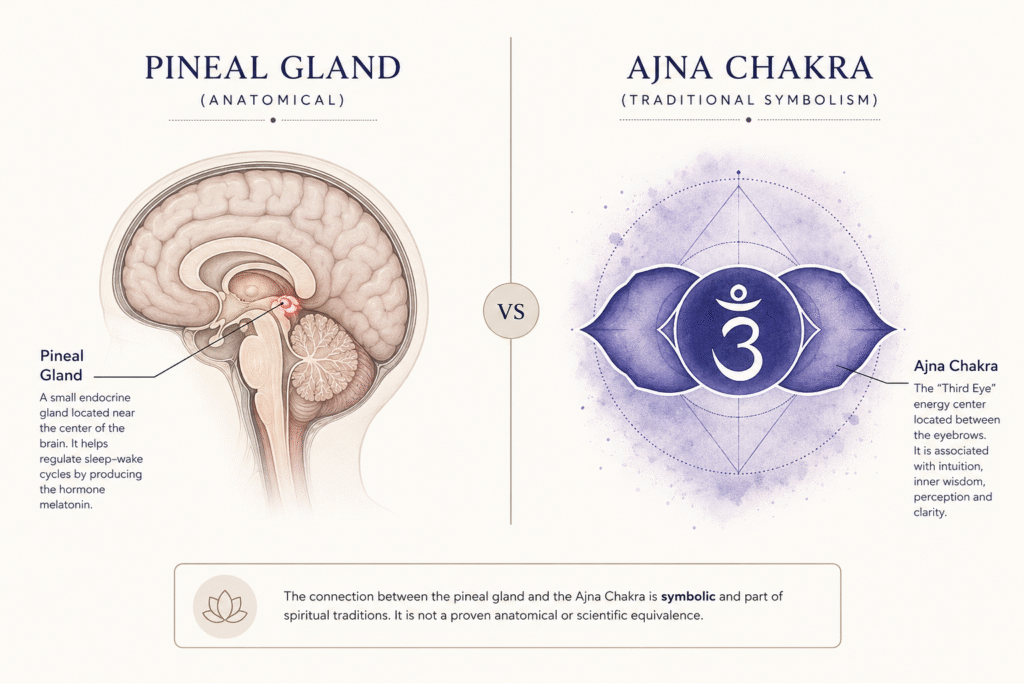
The Third Eye Chakra is traditionally located in the space between the eyebrows, often called the brow center. While many people point to the forehead when referring to the Third Eye, yogic teachings describe it primarily as an energetic center rather than a physical structure.
Some modern discussions draw symbolic parallels between the Third Eye and the pineal gland, a small endocrine gland located near the center of the brain that helps regulate sleep–wake cycles by producing melatonin.
It’s important to note that this connection is symbolic rather than scientifically established. Traditional yoga texts describe the Ajna Chakra in energetic and spiritual terms, whereas the pineal gland is a physical anatomical structure studied in modern medicine.
For many practitioners, the symbolism simply serves as a helpful bridge between ancient philosophy and contemporary understanding, reminding us that awareness includes both body and mind.
What Does the Third Eye Chakra Represent?
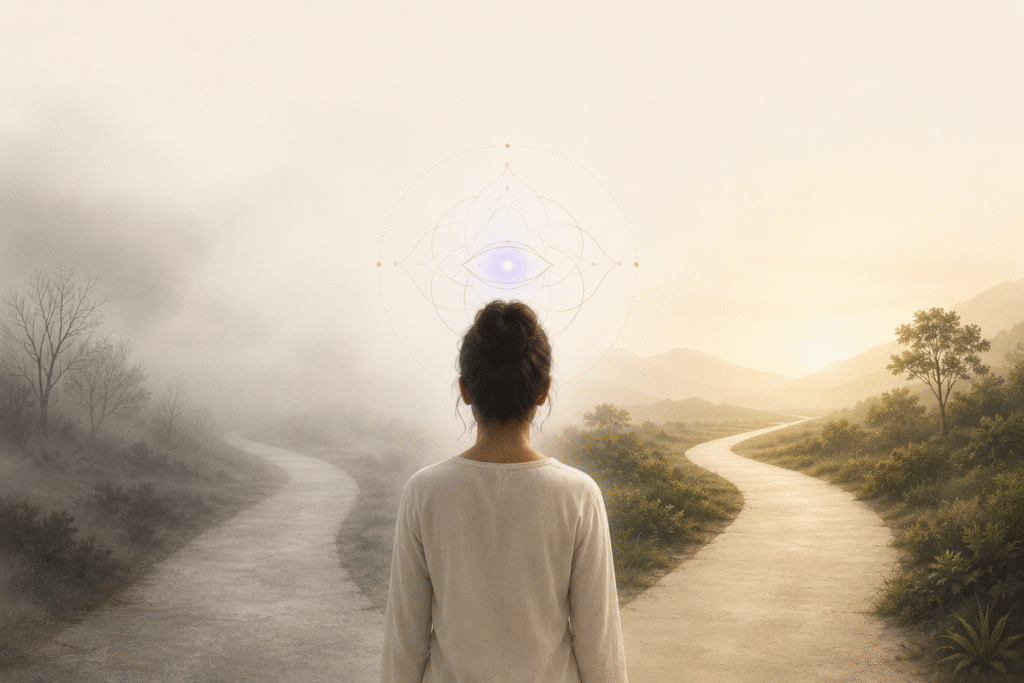
The Third Eye Chakra (Ajna) represents intuition, inner wisdom, and the ability to see beyond surface appearances. It encourages self-reflection, clear perception, imagination, and discernment, helping you distinguish between fear and truth. When this energy center is balanced, you become more aware of your thoughts, trust your inner guidance, and make decisions with greater clarity and confidence. Rather than predicting the future, the Third Eye Chakra supports a deeper understanding of yourself and the world around you, allowing you to navigate life with mindfulness, insight, and purpose.
Signs of a Balanced Third Eye Chakra
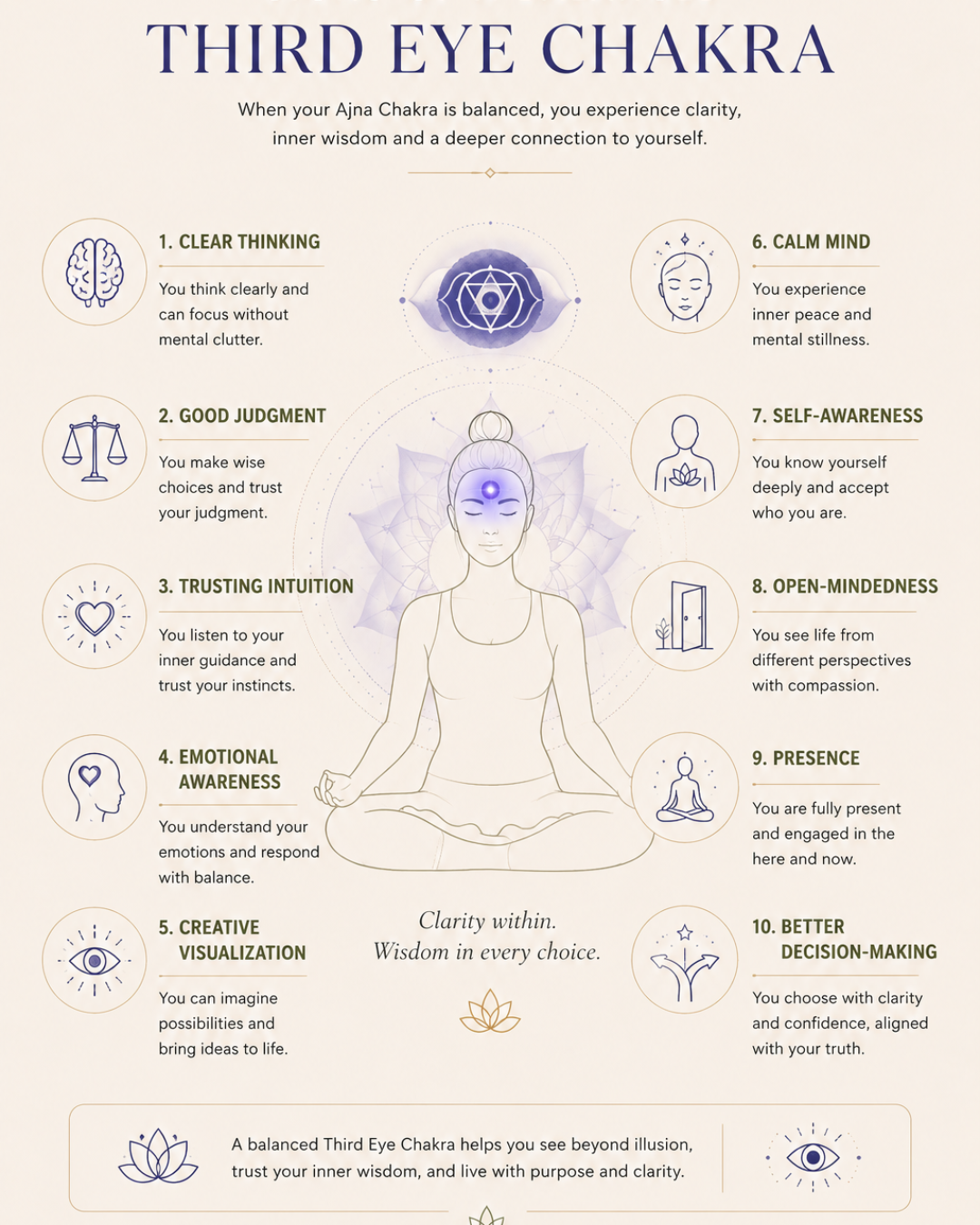
- Clear thinking
- Good judgment
- Trusting intuition
- Emotional awareness
- Creative visualization
- Calm mind
- Self-awareness
- Open-mindedness
- Presence
- Better decision-making
Signs of an Imbalanced Third Eye Chakra
Underactive
- Difficulty trusting yourself
- Confusion
- Lack of imagination
- Poor concentration
- Self-doubt
- Feeling disconnected
Overactive
- Overthinking
- Fantasy replacing reality
- Racing thoughts
- Mental exhaustion
- Obsessive analysis
- Spiritual bypassing
Include a reminder that these experiences can have many causes and are not diagnostic of a chakra imbalance alone.
What Blocks the Third Eye Chakra?
Include practical discussion on:
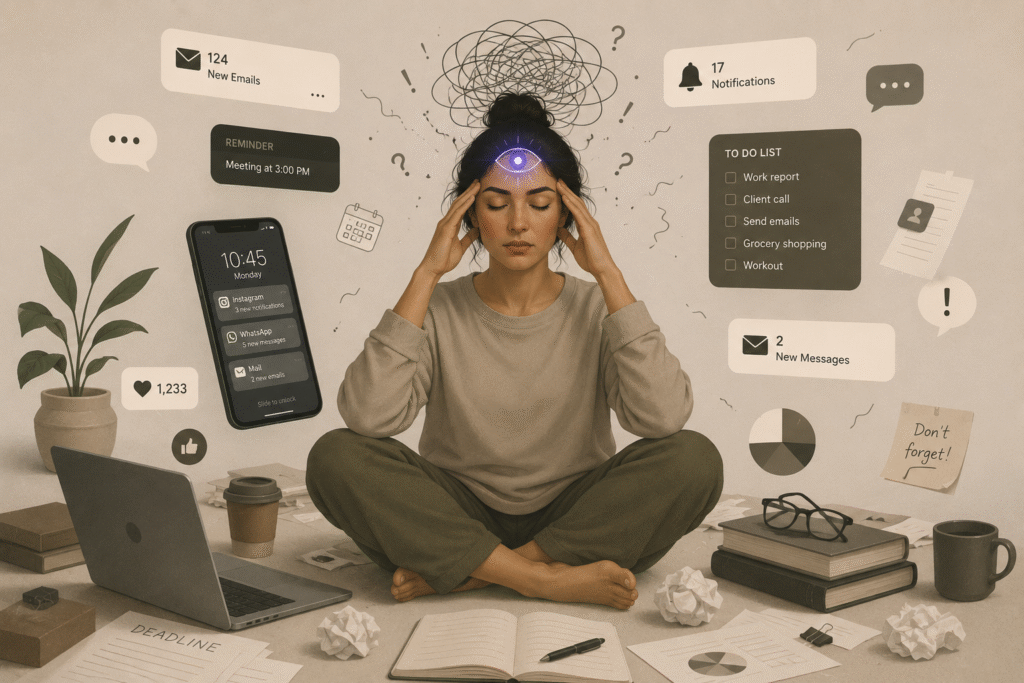
- Chronic stress
- Constant digital stimulation
- Sleep deprivation
- Fear of making mistakes
- Lack of reflection
- Ignoring intuition
- Information overload
Yoga Poses for the Third Eye Chakra
Include detailed sections with benefits, alignment cues, and contraindications where appropriate.
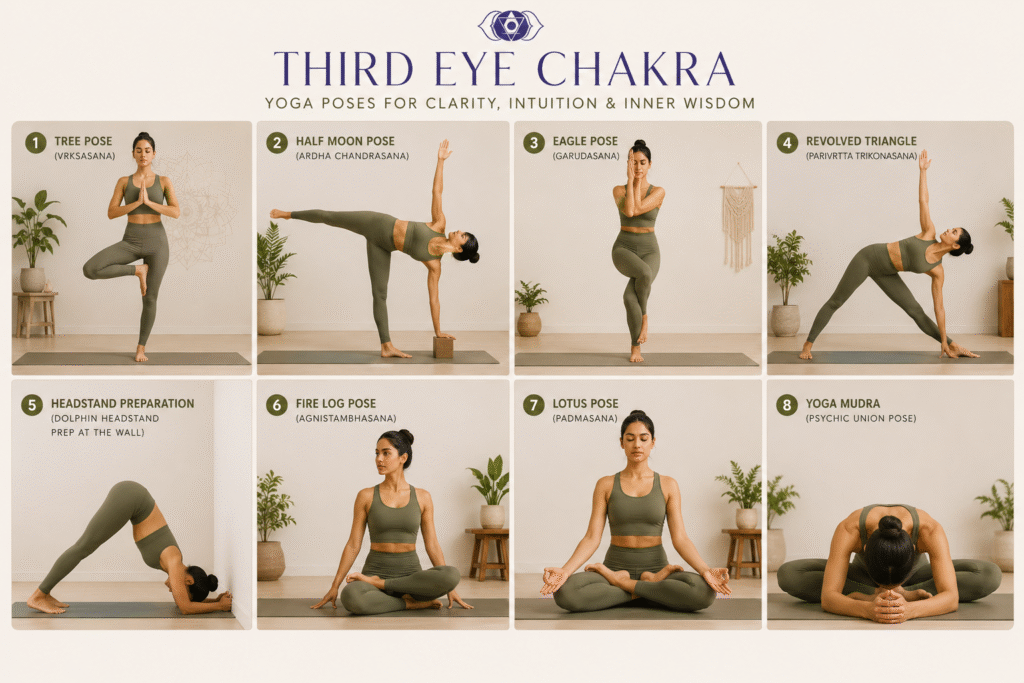
1. Tree Pose (Vrksasana)
Why it support Ajna
Balancing on one leg requires unwavering concentration and a steady gaze (drishti). This cultivates mental focus, clarity, and presence, qualities associated with the third eye chakra.
Benefits
- Improves concentration
- Develops balance
- Enhances body awareness
- Encourages mental stillness
2. Half Moon Pose (Ardha Chandrasana)
This balancing posture challenges your awareness while encouraging calm, focused attention.
Benefits
- Builds focus
- Improves spatial awareness
- Develops confidence
- Strengthens the nervous system
3. Eagle Pose (Garudasana)
One of the best poses for cultivating one-pointed concentration.
The fixed gaze and wrapped limbs encourage inward awareness instead of external distraction.
Benefits
- Improves concentration
- Develops balance
- Encourages mindfulness
- Enhances coordination
4. Revolved Triangle (Parivrtta Trikonasana)
Twisting poses require mindful movement and coordination.
They encourage practitioners to move slowly with awareness rather than rushing.
Benefits
- Improves concentration
- Develops coordination
- Encourages mindful movement
- Stimulates spinal mobility
5. Headstand Preparation (Dolphin Headstand Prep at the Wall)
Instead of a full headstand (which isn’t suitable for everyone), use a beginner-friendly preparation.
The gentle inversion supports alertness while teaching patience and focus.
Benefits
- Encourages concentration
- Develops confidence
- Improves upper-body strength
- Introduces safe inversion practice
6. Fire Log Pose (Agnistambhasana)
This deep hip-opening meditation posture encourages stillness.
Excellent preparation for seated meditation.
Benefits
- Releases stored tension
- Encourages introspection
- Improves meditation posture
- Promotes calmness
7. Lotus Pose (Padmasana)
Unlike the Heart or Throat Chakra blogs, where movement was emphasised, the lotus is the traditional meditation posture associated with higher awareness.
Benefits
- Supports meditation
- Encourages mental clarity
- Promotes steady breathing
- Improves concentration
8. Yoga Mudra (Psychic Union Pose)
One of the most overlooked traditional yogic poses.
Performed in a seated posture with a gentle forward fold, yoga mudra symbolises surrender of the ego and turning awareness inward.
It beautifully reflects the qualities of the third eye chakra.
Benefits
- Encourages introspection
- Calms the mind
- Supports meditation
- Improves breath awareness
10-Minute Third Eye Chakra Guided Meditation
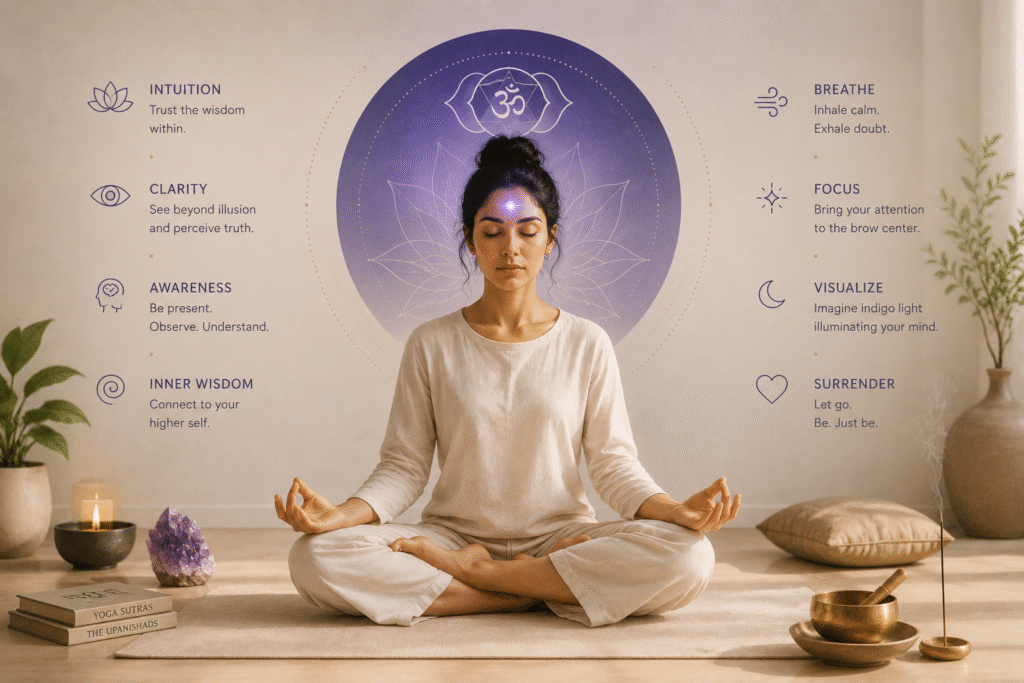
Find a quiet space where you can sit or lie down comfortably without distractions. Rest your hands gently on your knees or in your lap, lengthen your spine, and softly close your eyes.
Minute 1–2: Settle into Your Breath
Begin by bringing your awareness to your natural breath. There’s nothing to change or control—simply observe each inhale and exhale.
With every inhale, invite a sense of calm into your body.
With every exhale, release any tension, worry, or mental chatter.
Allow your shoulders to soften, relax your jaw, and let your face become gentle. Feel yourself becoming fully present in this moment.
Minute 3–4: Connect with Your Brow Center
Now bring your attention to the space between your eyebrows, the traditional location of the Third Eye Chakra, or Ajna.
Without forcing anything, simply notice this area.
Imagine your breath naturally flowing toward this point. With each inhale, feel a sense of spaciousness. With each exhale, allow your mind to become quieter and more settled.
Minute 5–7: Visualize Indigo Light
Picture a soft indigo light beginning to glow at your brow center.
At first, it may appear as a small point of light. Gradually, allow it to grow brighter and warmer, surrounding your forehead with a peaceful indigo glow.
With every breath, imagine this light expanding gently, filling your mind with clarity, wisdom, and inner stillness.
Silently repeat these affirmations:
- I trust my inner wisdom.
- My mind is calm and clear.
- I welcome insight with an open heart.
- I see myself and the world with clarity.
There is nothing to force or achieve. Simply allow yourself to rest within this gentle awareness.
Minute 8–9: Observe Your Thoughts
As thoughts arise, notice them without judgment.
Imagine each thought as a cloud drifting across a vast blue sky.
You do not need to hold onto them or push them away.
Simply observe them passing by, returning your attention to your breath and the indigo light whenever your mind begins to wander.
With each passing moment, notice the quiet space that exists between your thoughts.
Minute 10: Return with Awareness
Take a slow, deep inhale through your nose.
Exhale gently through your mouth.
Begin to notice the feeling of your body resting on the floor or chair. Wiggle your fingers and toes, gently roll your shoulders, and slowly bring movement back into your body.
When you’re ready, softly open your eyes.
Carry this sense of clarity, presence, and inner awareness with you as you move through the rest of your day, remembering that your intuition becomes easier to hear when your mind is calm.
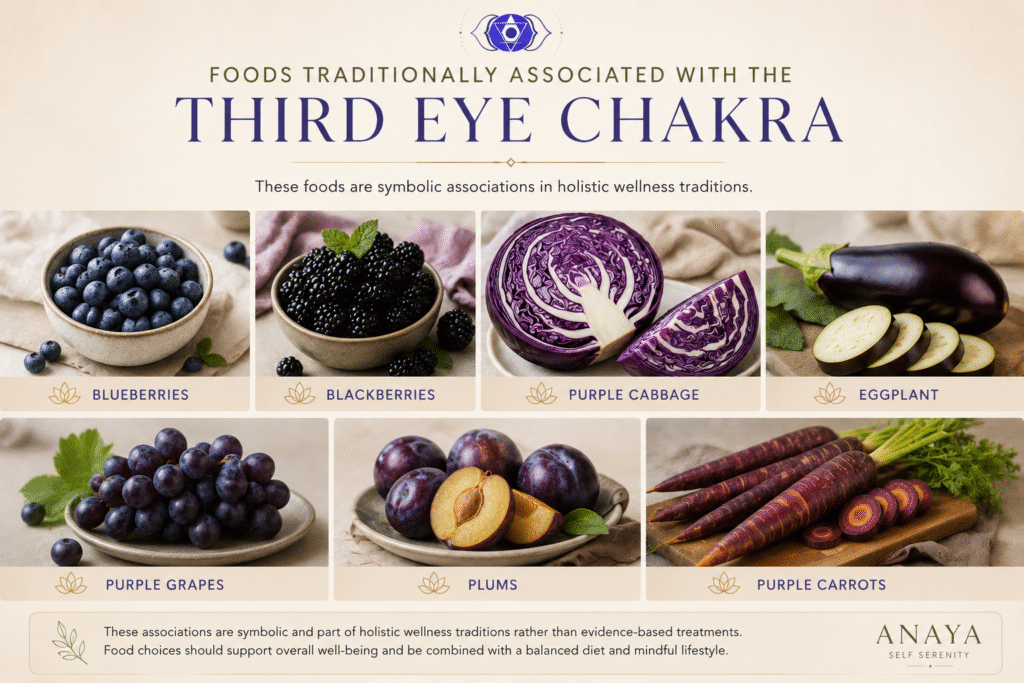
Foods Traditionally Associated with the Third Eye Chakra
Examples often associated in modern chakra traditions include:
- Blueberries
- Blackberries
- Purple cabbage
- Eggplant
- Purple grapes
- Plums
- Purple carrots
Clarify that these associations are symbolic and part of holistic wellness traditions rather than evidence-based treatments.
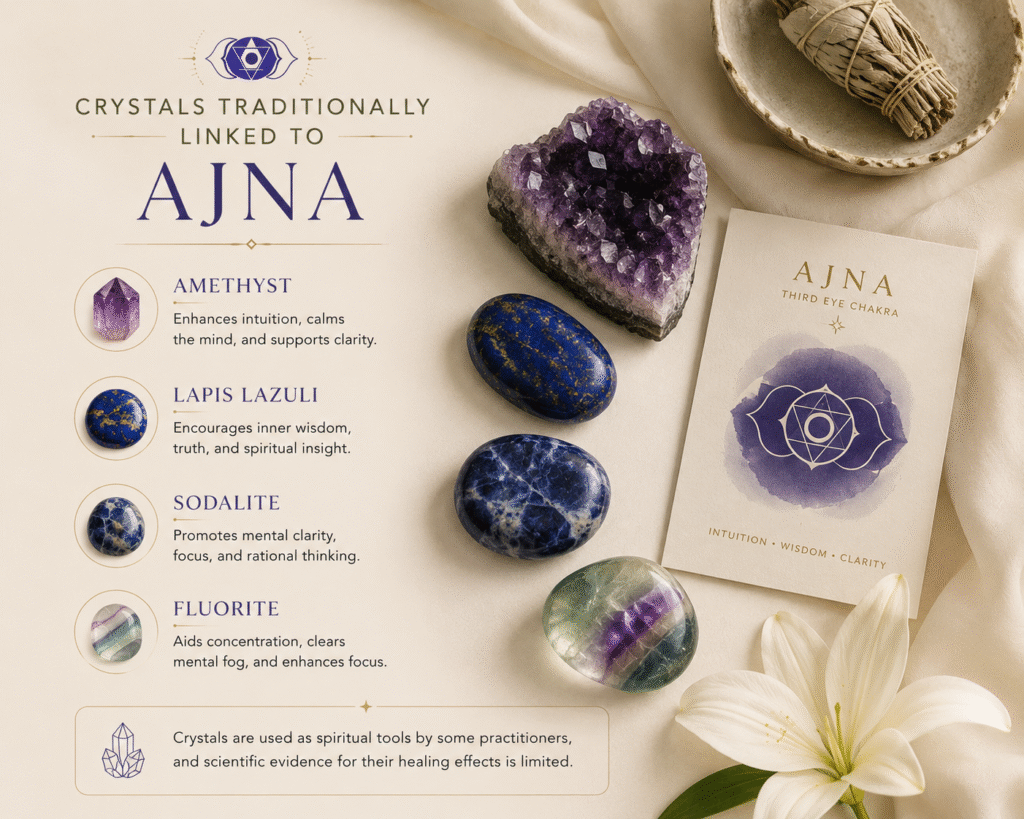
Crystals Traditionally Linked to Ajna
- Amethyst
- Lapis Lazuli
- Sodalite
- Fluorite
Include a note that crystals are used as spiritual tools by some practitioners, and scientific evidence for their healing effects is limited.
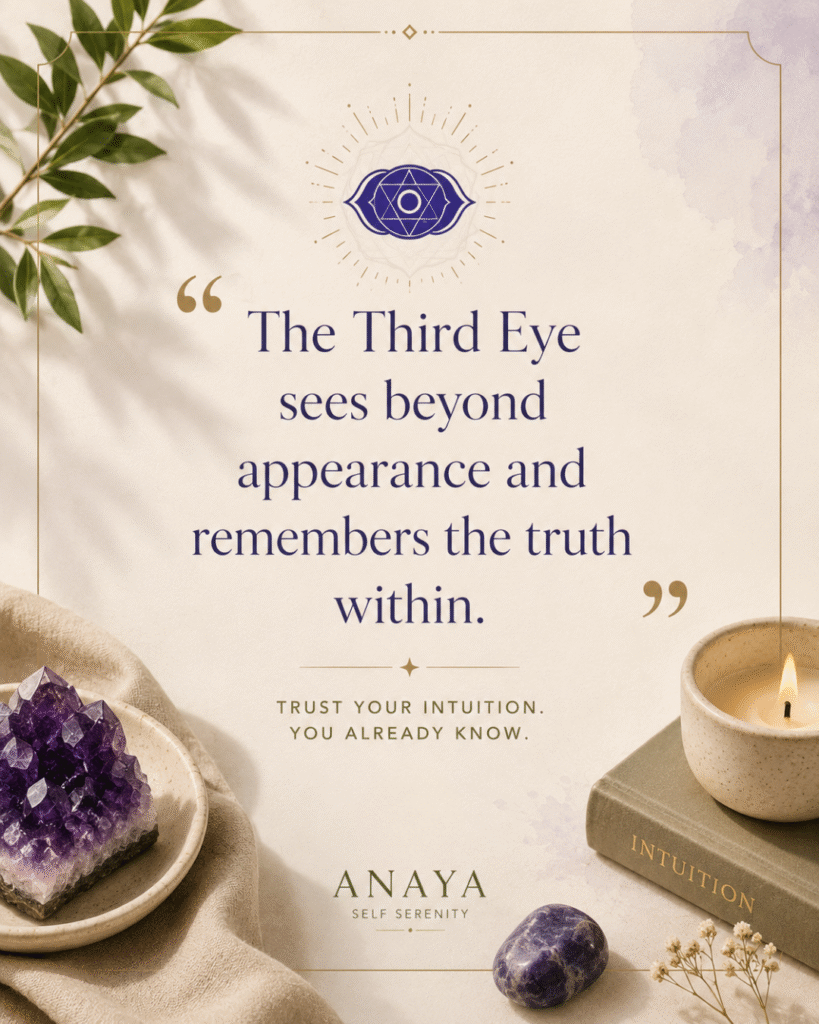
Third Eye Chakra Affirmations,
such as:
- I trust my inner wisdom.
- I see with clarity and compassion.
- My intuition guides me with balance.
- I welcome insight with an open mind.
- I am connected to my inner knowing.
- I choose clarity over confusion.
- I observe without judgement.
- My mind is calm and focused.
- I make decisions with confidence.
- I embrace truth with courage.
- I am open to learning and growth.
- I honour both intuition and reason.
Daily Practices to Support the Third Eye Chakra
Discuss habits such as journaling, mindful walks, reducing screen time before bed, reflective reading, meditation, creative visualization, and adequate sleep. Emphasize consistency over intensity.
Common Myths About the Third Eye Chakra
Address misconceptions, for example:
- It does not guarantee psychic abilities.
- Awakening is not an overnight event.
- Intuition complements critical thinking rather than replacing it.
- Practices should remain grounded and respectful of individual beliefs.
FAQs
What is the Third Eye Chakra?
The Third Eye Chakra, known as Ajna in Sanskrit, is the sixth of the seven primary chakras. Located between the eyebrows, it is traditionally associated with intuition, perception, inner wisdom, and mental clarity. Rather than representing supernatural abilities, it encourages self-awareness, thoughtful decision-making, and a deeper understanding of yourself and the world around you.
How do I know if my third eye chakra is balanced?
A balanced third eye chakra is often reflected in your ability to think clearly, trust your intuition, and remain emotionally aware. You may notice improved concentration, better decision-making, a calm mind, and an openness to different perspectives. While these qualities are commonly associated with Ajna in yogic traditions, they can also be influenced by many aspects of your overall well-being.
Can yoga help support Third Eye awareness?
Yes. Yoga can help create the mental stillness and self-awareness that are traditionally linked to the Third Eye Chakra. Balance poses, mindful forward folds, gentle inversions, breathwork, and meditation encourage concentration and present-moment awareness. Regular practice supports a calmer mind, making it easier to notice your inner thoughts and intuition.
Is the Third Eye Chakra the same as the pineal gland?
No. The Third Eye Chakra and the pineal gland are not the same thing. The Third Eye Chakra is an energetic concept described in yogic philosophy, while the pineal gland is a physical endocrine gland within the brain that helps regulate sleep through the production of melatonin. Some modern spiritual traditions draw a symbolic connection between the two, but this relationship is philosophical rather than scientifically established.
How long does it take to notice changes from meditation?
There is no fixed timeline, as every person’s experience is different. Some people notice a greater sense of calm and focus after a few meditation sessions, while developing deeper mindfulness and self-awareness usually comes through consistent practice over weeks or months. The goal is not to “open” the Third Eye quickly but to cultivate clarity, presence, and a balanced relationship with your thoughts over time.
Conclusion
The Third Eye Chakra reminds us that clarity often begins with stillness. By cultivating mindfulness, thoughtful self-reflection, and consistent practices such as yoga, breathwork, and meditation, we can strengthen our ability to respond to life with greater awareness.
Rather than seeking extraordinary experiences, working with Ajna encourages us to notice the wisdom already available within us. When intuition is balanced with discernment, we become better equipped to navigate uncertainty with confidence and compassion.
At ANAYA Self Serenity, we believe that yoga is a lifelong journey of self-discovery—one breath, one practice, and one moment of awareness at a time.