

Ancient wisdom, modern distraction, and the enduring human search for inner clarity
By ANAYA Self Serenity
There is a curious contradiction at the centre of modern life:
Never before have human beings been surrounded by so much information, and yet so many confess to feeling uncertain about what they truly know.
We scroll endlessly, consume opinions at unprecedented speed, and gather facts with remarkable efficiency. But wisdom, the quiet ability to perceive what matters, remains elusive.
Ancient yogic traditions anticipated this dilemma centuries ago.
They spoke of a subtle centre of awareness known as Ajna Chakra, the Third Eye, a place not of supernatural vision but of insight, discernment, intuition, and conscious perception. Situated at the point between the eyebrows, Ajna has long been described as the meeting ground between intellect and inner knowing, where duality gives way to understanding.
In Sanskrit, “Ajna” translates to “command”, “perception”, or “to know”. It is considered the sixth primary chakra within the traditional yogic system and represents the faculty through which human beings learn not merely to observe life but to truly see it.
What Is the Third Eye Chakra?
The Third Eye Chakra, or Ajna, resides in the subtle body at the space between the eyebrows, known in yogic practice as Bhrumadhya, the eyebrow centre.
Traditional texts describe it as a luminous two-petalled lotus, symbolising the union of opposing energies: intuition and logic, moon and sun, Ida and Pingala, the dual currents that converge before consciousness ascends toward higher awareness.
Unlike lower chakras, Ajna is not associated with a classical element such as earth, water, fire, air, or ether. Instead, it governs the mind, perception, and wisdom itself.
Its seed mantra is traditionally OM (AUM), the primordial vibration believed to underlie all existence. The chakra is commonly represented through indigo or deep violet hues, though classical sources frequently describe it as brilliant white, a reminder that symbolic colour systems have evolved.
The Ancient Origins of Ajna
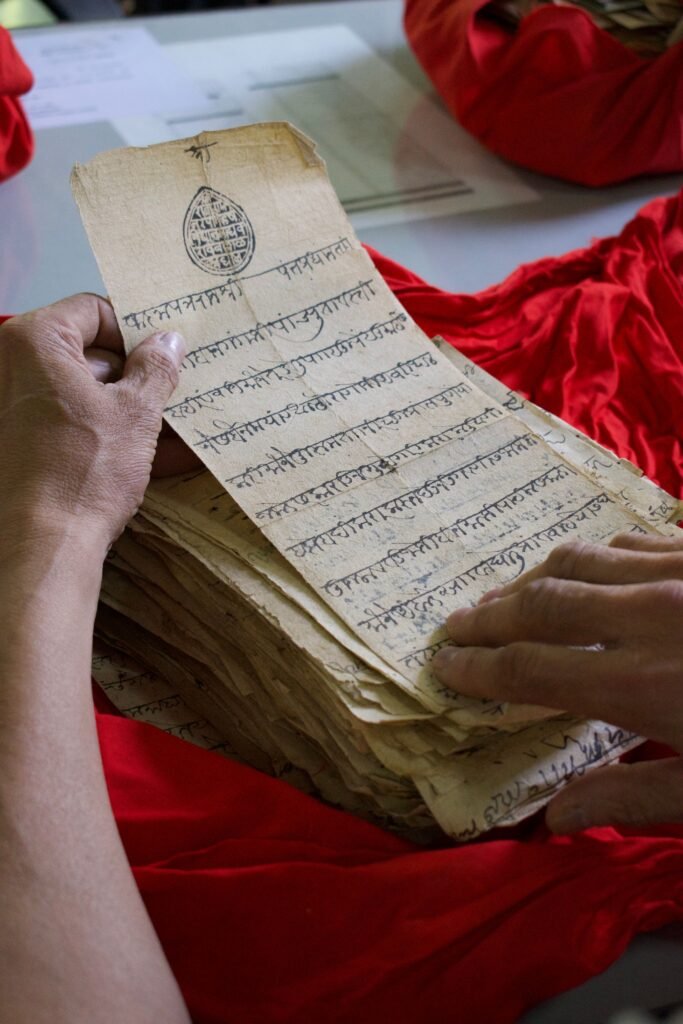
Modern wellness culture often presents chakras as fixed psychological categories, yet historically, their meanings emerged through centuries of philosophical and tantric development.
One of the most influential descriptions appears in the Ṣaṭ-Cakra-Nirūpaṇa, a sixteenth-century Sanskrit text attributed to Purnananda Swami and later translated into English by Arthur Avalon in The Serpent Power. The text portrays Ajna as a radiant lotus with two petals bearing the Sanskrit syllables Ha and Ksha, presided over by divine consciousness itself.
The symbolism is profound.
The two petals represent the final integration of duality. The wandering currents of the mind—reason and imagination, action and surrender, masculine and feminine energies—meet here before dissolving into unity. The yogic journey, in this understanding, is not about acquiring extraordinary powers but about transcending fragmentation.
To awaken the Third Eye, therefore, is to cultivate clarity rather than mysticism.
It is learning to perceive reality without distortion.
Intuition Is Not Magic; It Is Refined Awareness
Popular culture often associates the Third Eye with psychic abilities, clairvoyance, or supernatural experiences.
Traditional yoga offers a subtler perspective.
Intuition, in classical teachings, is not an escape from reason; it is reason matured through stillness. It emerges when mental noise subsides, and deeper patterns become visible.
Modern psychology might call this ‘integrative thinking’, the capacity to synthesise memory, emotion, observation, and experience into coherent understanding.
The yogic tradition simply calls it wisdom.
A balanced Ajna chakra allows individuals to:
- Trust their inner guidance without abandoning logic.
- See beyond immediate emotional reactions.
- Discern truth from distraction.
- Remain connected to purpose during uncertainty.
- Hold paradox without rushing towards simplistic answers.
In many ways, the Third Eye is less about seeing extraordinary things and more about seeing ordinary life with extraordinary clarity.
Signs of a Balanced Third Eye Chakra
When Ajna is in harmony, practitioners often describe experiences of mental spaciousness and inner steadiness.
Common qualities include:
Clear Perception
The ability to observe situations without excessive judgement or emotional distortion.
Strong Intuition
An increased trust in inner wisdom developed through reflection rather than impulse.
Creative Vision
Imagination that remains grounded in reality and purposeful action.
Concentration and Presence
Improved focus, meditation, and sustained attention.
Spiritual Curiosity
A desire to explore life’s deeper questions while remaining rooted in everyday experience.
When the Third Eye Becomes Clouded
Ancient teachings suggest that imbalance within Ajna may manifest as confusion, overthinking, or disconnection from one’s inner compass.
Modern life offers countless opportunities for such an imbalance.
Constant notifications, information overload, and perpetual comparison create conditions in which perception becomes fragmented.
Some individuals may experience:
- Chronic indecision.
- Mental exhaustion.
- Lack of direction.
- Difficulty trusting themselves.
- Excessive attachment to external validation.
- Creative stagnation.
- Persistent over-analysis.
It is important to recognise that these experiences are human and multifaceted. Spiritual traditions provide symbolic frameworks for understanding them, but they should not replace professional medical or psychological care when needed.
The language of chakras serves as metaphor, philosophy, and contemplative practice, not clinical diagnosis.
The Symbolism Hidden Within the Two-Petaled Lotus
Every aspect of Ajna’s imagery carries meaning.
The Two Petals
Traditionally associated with Ida and Pingala, the lunar and solar energy channels that intersect at the brow centre. Their union symbolises harmony between intuition and intellect.
The Inverted Triangle
A downward-pointing triangle often appears at the centre of the symbol, representing wisdom descending into human consciousness.
The Colour Indigo
Though historical descriptions vary, indigo has become a contemporary symbol for introspection, mystery, and expanded awareness.
The Mantra OM
The sacred syllable AUM embodies creation, preservation, dissolution, and the silence beyond all sound, a fitting emblem for the chakra associated with higher perception.
Meditation as the Practice of Seeing
The cultivation of the Third Eye does not require extraordinary rituals.
It begins with attention.
In classical yoga, practitioners focus gently on Bhrumadhya, the point between the eyebrows, allowing awareness to settle without force.
The practice is simple:
Sit comfortably.
Close your eyes.
Breathe naturally.
Allow thoughts to arise and dissolve.
Observe rather than control.
Return, again and again, to stillness.
The intention is not to see visions.
The intention is to see oneself more clearly.
Over time, this discipline strengthens concentration, refines discernment, and develops what ancient teachers described as inner sight.
Yoga Practices That Support Ajna Chakra
Movement traditions connected to the Third Eye emphasise balance, inversion, focus, and mindful awareness.
Child’s Pose (Balasana)
Encourages introspection and surrender.

Eagle Pose (Garudasana)
Develops concentration and mental steadiness.

Dolphin Pose
Builds strength while preparing the body for inversions.

Supported Headstand (Sirsasana)
Traditionally regarded as a posture that encourages inward focus when practised safely and appropriately.

Seated Meditation (Sukhasana)
Perhaps the most important posture of all. Because insight rarely arrives through striving. It arrives through presence.

The Pineal Gland: Science and Symbolism
Modern discussions frequently link the Third Eye to the pineal gland.
The association is compelling but requires nuance.
The pineal gland is a small endocrine structure responsible for regulating melatonin production and sleep cycles. While some spiritual traditions symbolically connect it to higher consciousness, contemporary science does not recognise chakras as anatomical entities.
The relationship, therefore, is best understood as a metaphor rather than a medical fact.
Ancient yogis described subjective states of awareness long before neuroscience had the vocabulary to explore human consciousness. The two perspectives need not compete.
They speak different languages.

In an Age of Noise, The Third Eye Invites Silence
The modern world rewards reaction.
The Third Eye asks for reflection.
It encourages a slower form of intelligence, one that listens before speaking, observes before concluding, and trusts that not every answer arrives immediately.
Perhaps that is why Ajna remains so enduringly relevant.
Because amid endless information, human beings continue to seek wisdom.
Because clarity still matters.
Because seeing is not the same as understanding.
And because somewhere between reason and intuition lies a quieter truth:
The most important vision we cultivate is not the ability to look further into the future.
It is the courage to look more honestly within.
A Gentle Practice for Awakening Inner Clarity
Tonight, before sleep, sit comfortably for five minutes.
Close your eyes.
Place your attention softly at the centre of the brow.
Inhale.
Exhale.
Ask yourself one question:
“What truth have I been too distracted to notice?”
Do not search for an answer.
Simply listen.
Sometimes, wisdom arrives not as revelation but as silence finally given room to speak.